Denton Holme is an inner city district in Carlisle, Cumbria, England. The population of this ward was 6,383, according to the 2011 census.

Denton Holme is usually regarded as a "village within the city" and is situated to the immediate south west of the city centre on the western bank of the River Caldew. A man-made stream or mill race known as the Little Caldew flows through and underneath the area.

Today it is mostly a residential area, but in the nineteenth century and most of the twentieth century, along with the neighbouring districts of Caldewgate and Wapping, it was Carlisle's main industrial district with many textile mills, engineering works and other factories such as car seat manufacturers and confectioners. Very few factories remain today, although the last mill, Ferguson Brothers, owned by Coats Viyella, at Holme Head, only closed in the 1990s.

Most of the housing is red-brick terraced, and a few are listed buildings, such as Bridge Terrace, built in the 1850s. Many side streets are still cobbled rather than tarmacked, although some new housing has been built recently, and some former factories have been converted into flats. The main street, Denton Street, has many small shops and other businesses, including a bingo hall and a branch of the Cumberland Building Society, which closed in 2024. There was also a cinema in the suburb located in what is now the Bingo hall. There is a primary school at Holme Head, built by and named after Robert Ferguson, and the former Morley Street School has been converted into a public library. Four churches are in Denton Holme: the Church of England Parish Church, St James, Carlisle Christian Fellowship, and The Lighthouse Baptist Church. At Shaddon Mill, on the boundary of Denton Holme and Caldewgate, stands a very tall chimney which was once the tallest in the UK. This structure, known as "Dixon's Chimney," is now slightly short of its original height, has recently been restored, and is a well-known local landmark. It is named after its first owner, Peter Dixon, who built the mill in 1835–6. The architect was Richard Tattersall. Labour Member of Parliament Julie Minns, elected as the first female MP for Carlisle at the 2024 UK general election, was born in the district.

Nearby Places View Menu
Location Image
275 m

City of Carlisle

The City of Carlisle ( kar-LYLE, locally KAR-lyle) was a local government district of Cumbria, England, with the status of a city. It was named after its largest settlement, Carlisle, but covered a far larger area which included the towns of Brampton and Longtown, as well as outlying villages including Dalston, Scotby and Wetheral. In 2011 the district had a population of 107,524, and an area of 1,039.97 square kilometres (402 sq mi). The district boundaries were set as part of the provisions of the Local Government Act 1972, and covered an amalgamation of two former local government districts, the City and County Borough of Carlisle and the Border Rural District of Cumberland. The district shared a border with Scotland (to the north), and was bounded on the southwest by the borough of Allerdale, and on the south by the district of Eden. The county of Northumberland was to the east. Although the district boundaries dated to the 20th century, the city traces its origins to a 1st-century Roman outpost associated with Hadrian's Wall. The Brythonic settlement that expanded from this outpost was destroyed by the Danes in 875. Thereafter the region formed part of the Southern Uplands of Scotland, until colonised under King William II of England in 1092. William II built Carlisle Castle, which houses a military museum. Carlisle Cathedral, founded in the 12th century, is one of the smallest in England. A border city, and the third most northerly city in England, Carlisle district predominantly spanned the flood plain of the River Eden. Commercially, it was linked to the rest of England via the M6 motorway, and to the Scottish Lowlands via the A74(M) and M74 motorways. In July 2021 the Ministry of Housing, Communities and Local Government announced that in April 2023, Cumbria would be reorganised into two unitary authorities. On 1 April 2023, Carlisle City Council was abolished and its functions transferred to the new unitary authority of Cumberland, which also incorporates the former districts of Allerdale and Copeland. From 1 April 2023 the "City of Carlisle" was redefined to cover the following wards: Belah and Kingmoor, Botcherby and Harraby North, Cathedral and Castle, Currock and Upperby, Denton Holme and Morton South, Harraby South and Parklands, Newtown and Morton North, Sandsfield and Morton West and Stanwix and Houghton. In the light of Rochester's unintended loss of city status, Charter Trustees were formed from the councillors that cover Carlisle's wards; they act as appropriate bodies in which historic rights and privileges of Carlisle, including the Mayoralty will continue, subject to future governance reviews.
Location Image
403 m

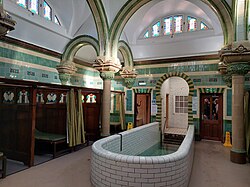
Carlisle Turkish baths

The Carlisle Turkish baths were an Edwardian public baths in Carlisle, Cumbria, England. They adjoined the city's 1884 swimming pool and were constructed in 1908-1909. The baths offered saunas, plunge pools and shower and were advertised as providing health benefits to patrons. These typical Victorian-style Turkish baths remained in use until November 2022 and retain their original tiling and faience work, which is of unusually good quality. A local campaign is seeking to reopen the baths.
Location Image
427 m

Dixon's Chimney and Shaddon Mill

Shaddon Mill is a former cotton mill in Carlisle, Cumbria, England. Both the mill and its 290 feet (88 m) tall chimney, named Dixon's Chimney after its builder, Peter Dixon, are Grade II listed buildings. In 2019, a man died after slipping from the chimney and hanging suspended from it for several hours.
Location Image
500 m

Carlisle railway station

Carlisle, or Carlisle Citadel, is a Grade II* listed railway station serving the cathedral city of Carlisle, in Cumbria, England. It is a principal stop on the West Coast Main Line, 102 miles (164 km) south-east of Glasgow Central and 299 miles (481 km) north-north-west of London Euston. It is the northern terminus of the Settle and Carlisle Line. The station is so named because it is adjacent to Carlisle Citadel, a former medieval fortress (not to be confused with Carlisle Castle). The station is owned by Network Rail. In September 1847, the first services departed the station, even though construction was not completed until the following year. It was built in a neo-Tudor style to the designs of English architect William Tite. Carlisle station was one of a number in the city; the others were Crown Street and London Road, but it became the dominant station by 1851. The other stations had their passenger services redirected to it and were closed. Between 1875 and 1876, the station was expanded to accommodate the lines of the Midland Railway which was the seventh railway company to use it. The Beeching cuts of the 1960s affected Carlisle, particularly the closure of the former North British Railway lines to Silloth, on 7 September 1964, and the Waverley Line to Edinburgh Waverley via Galashiels on 6 January 1969. The closure programme claimed neighbouring lines, including the Castle Douglas and Dumfries Railway and Portpatrick Railway (the "Port Road") in 1965; this resulted in a significant mileage increase via the Glasgow South Western Line and Ayr to reach Stranraer Harbour and ferries to Northern Ireland. The station layout has undergone few changes other than the singling of the ex-NER Tyne Valley route to London Road Junction in the 1972–73 resignalling scheme, which was associated with the electrification of the West Coast Main Line (WCML). Renovations to the platforms and glass roof were performed between 2015 and 2018.