


Cafè del Teatre de l'Escorxador, or Cafè del Teatre for short, is a concert venue in Lleida (Catalonia, Spain) opened as an addition to the Teatre Municipal de l'Escorxador. Its address is Carrer de Roca Labrador 4 bis. Among its recurrent events are Cafècurt, monthly short-film screening sessions, some activities of the Lleida Latin-American Film Festival, jam sessions and other live shows, especially jazz-oriented music and rock.
Location
23 m
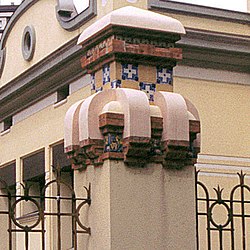
Teatre Municipal de l'Escorxador is a theatre on carrer de Lluís Companys, in the Templers-Instituts quarter of Lleida, Catalonia, Spain. It's remarkable for its striking modernista-Art Nouveau architecture, unusual for a former slaughterhouse, a work by the Tarragona-born architect Francesc de Paula Morera i Gatell, nowadays refurbished and complete with some 1990s additions. It was heavily damaged during the Spanish Civil War bombings. It has been in operation since 1998, and is owned by the Lleida city council. It has two stages: Sala 1, an Italian-style hall with 310 seats, and Sala 2, used for plays and performances of a more experimental sort. There's a third space located in the former convent of Saint Theresa. Next to it is the Cafè del Teatre.

288 m
Instituts-Templers is a district of Lleida, Catalonia, Spain. It's made up of different areas between La Mariola, Universitat and the river Segre, mostly working-class, some middle class. "Templers-Escorxador" is located within the portion of medieval Lleida which was once owned by the Knights Templar, hence the name. "Instituts" refers to the oldest public secondary institutes or high-schools of the 20th century town, that dominate the area next to Gardeny. It has undergone serious urban regeneration during the 1990s and especially the 2000s. It had over 15000 inhabitants in 2009. The Battle of Ilerda took place in this area of Roman-era Lleida, then called Ilerda.

358 m
Rambla d'Aragó is an important thoroughfare in the Universitat district of Lleida, Catalonia, Spain. Originally a rambla with a pedestrianised area complete with a marketplace and a service of trams, it underwent several changes and is now a regular street crossed by cars. It originates at Plaça de Cervantes and ends in Avinguda Catalunya. It hosts the former Maternity home, now Lleida Public Library, the art-nouveau buildings Cases Balasch, the Lleida Bishopric Palace, the Museu de Lleida Diocesà i Comarcal, as well as the main University of Lleida campus, built in 19th-century neo-Gothic style.

365 m
The Public Library of Lleida, also formerly called Biblioteca Pública de la Maternitat, is a public library in the city of Lleida. Its legal owner is the Generalitat de Catalunya. The building was originally a 19th-century maternity house, that is, an orphanage located in the Rambla d'Aragó and has operated as the town's main library since 1998, when it was heavily reformed.
It contains over 150,000 books and 9,760 printed documents from the 16th to the 19th century, 6 manuscripts, and 25 incunables. The library's two cloysters are often used for artistic and cultural exhibitions, often related to local artists or focusing on social issues, including one in 1998 on its own past as an orphanage.

412 m
Avinguda de Catalunya is a thoroughfare in the city of Lleida, Spain. On one end it is a prolongation of Rambla d'Aragó while on the other it meets Plaça d'Espanya and the river Segre. An extension into the Cappont neighbourhood, on the other side of the river, through the Pont de la Universitat, is underway. Most buildings are relatively recent, and include the infamous Edifici dels Sindicats, or Labor Union building, also called the "Ducados building" because of its alleged resemblance to a Ducados blue cigarette box. Demonstrations in Lleida usually go through Avinguda de Catalunya. The Lleida coach station, a rather decayed infrastructure, lies on one of the ends of the avenue as of 2010. It will be replaced by a newer structure near the Lleida-Pirineus railway station.
See also
Culture in Lleida