


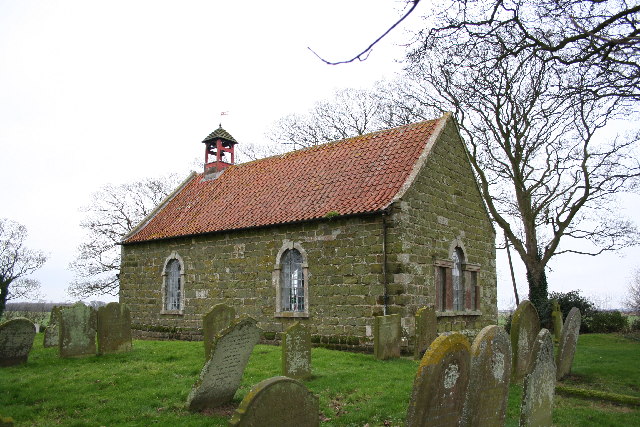
Hannah cum Hagnaby est une paroisse civile et un village du Lincolnshire, en Angleterre.
Location
1 explorer visited this place

4 m
Hannah cum Hagnaby is a civil parish in the East Lindsey district of Lincolnshire, England. It is situated approximately 4 miles north-east from Alford, and 15 miles south-east from Louth. The parish contains two small hamlets, Hannah and Hagnaby.
Hannah was used in the Bronze Age as there is evidence of a Round Barrow.
In antiquity Hannah was known as Hannay. The church, in Hannah, is dedicated to Saint Andrew and is a Grade I listed building, built of greenstone about 1758, with early 19th, and some 20th-century, alterations.
Hagnaby Priory, later Hagnaby Abbey, was in Hagnaby. Pevsner states that a Premonstratensian priory, founded in 1175, stood 0.5 miles to the north of the village. Fragments of the priory, including octagonal shafts and window tracery, exist at Hagnaby Abbey Farm 1.25 miles to the west. English Heritage has noted the existence of the suppressed priory through evidence of aerial photographs and building debris, and grassed foundations of a later formal garden and post-medieval house.
711 m
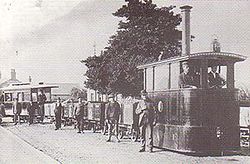
The Alford and Sutton Tramway was a steam 2 ft 6 in narrow gauge street tramway between the seaside town of Sutton-on-Sea and the nearby Great Northern Railway line at Alford in Lincolnshire.
1.3 km
Markby Priory was a priory in the village of Markby, Lincolnshire, England.
It is believed the Augustinian Priory was founded during the reign of Henry II, although there is no mention of it before 1204. The founder, Ralf Fitz Gilbert, was already dead, and his lands in the possession of his grandson, Hugh. Another early benefactor was Alan of Mumby, who granted the Canons the church at Mumby and one at Wycliff, in Yorkshire.
In 1438 Bishop Alnwick made a visitation and recorded that this priory was in worse condition than any other in the county. The bishop prefaced his injunctions by saying that he had heard of many excesses here, both in religion and in the observation of rule, and in administration; and when he came he had found his worst expectations fulfilled, 'not even the shadow of religion,' he said, but debts, drinking, and suspicion of even worse sins.
The prior allowed that his house was 100 marks in debt, and that silence was badly kept throughout the monastery, even in the church and cloister; that neither senior nor junior canons practised contemplation, and that one Thomas Dugby was suspected of sinful intercourse with a woman at Markby. The sub-prior also allowed that religion was not kept, and seconded the complaints of the prior; on the other hand, all the canons joined in complaining of the incompetence of the prior, and negligence of the sub-prior. It was generally allowed that the canons went out without leave, and ate and drank in the town; one indeed went to his mother's house every day, and was almost the same as an apostate. Two went constantly to taverns.
Thomas Dugby confessed the sin of incontinence charged against him, and was put to penance. The prior felt it best to resign.
Things had improved somewhat by 1819 when Bishop Atwater visited, and found some irregularities but no great faults.
The last prior was John Penketh. In 1534 there were eight canons and the prior, and the priory was dissolved at the first Act of Suppression in 1536.
The thatched church at Markby is believed to have been built of stone from the old priory, and the bell is believed to be the priory's refectory bell.
The site of the priory is now occupied by a 16th-century Grade II listed farmhouse.

1.4 km
Markby is a village and civil parish in the East Lindsey district of Lincolnshire, England. It is situated approximately 4 miles north-east from Alford.
2.1 km
Hagnaby Abbey was an abbey and former priory in Hagnaby, Lincolnshire, England. It was one of nine Premonstratensian houses within the historical county.
It was founded as a house for Premonstratensian canons around 1175, by Agnes, widow of Herbert de Orreby. The priory was a dependency of Welbeck Abbey and named in honour of Saint Thomas the Martyr.
It achieved its independence and abbey status in 1250, and appears from surviving records to have been well run.
Hagnaby Abbey was suppressed in 1536, its last abbot being Edmund Toft. It is an ancient scheduled monument.