


Résultats détaillés de l'édition 2002 du tournoi de tennis professionnel masculin de Vienne. Cette dernière appartenant à la catégorie Int' Series Gold, s'est tenue du 7 au 13 octobre sur dur en intérieur. C'est la 29e édition du tournoi.
Location

23 m
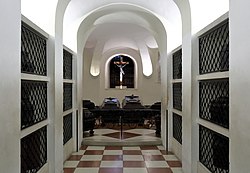
The Vergilius Chapel is an underground crypt next to the Stephansdom in Vienna. It is rectangular in form, with six niches. Today, it lies approximately 12 meters beneath the Stephansplatz.

30 m
The Stephansplatz is a square at the geographical centre of Vienna, Austria. It is named after its most prominent building, the Stephansdom, Vienna's cathedral and one of the tallest churches in the world. Before the 20th century, a row of houses separated Stephansplatz from Stock-im-Eisen-Platz, but since their destruction, the name Stephansplatz started to be used for the wider area covering both. To the west and south, respectively, run the exclusive shopping streets Graben and Kärntner Straße. Opposite the Stephansdom is the Haas-Haus, a piece of striking modern architecture by Hans Hollein. Although public opinion was originally skeptical about the combination of the mediaeval cathedral and the glass and steel building, it is now considered an example of how old and new architecture can mix harmoniously.

38 m
Vienna is the capital, most populous city, and one of the nine states of Austria. It is Austria's primate city, with just over two million inhabitants. Its larger metropolitan area has a population of nearly 2.9 million, representing nearly one-third of the country's population. Vienna is the cultural, economic, and political centre of the country, the fifth-largest city by population in the European Union, and the most populous of the cities on the river Danube.
The city lies on the eastern edge of the Vienna Woods, the northeasternmost foothills of the Alps, that separate Vienna from the more western parts of Austria, at the transition to the Pannonian Basin. It sits on the Danube, and is traversed by the highly regulated Wienfluss. Vienna is completely surrounded by Lower Austria, and lies around 50 km west of Slovakia and its capital Bratislava, 50 km northwest of Hungary, and 60 km south of Moravia.
The Romans founded a castrum at Vienna, which they called Vindobona, in the 1st century, when the region belonged to the province of Pannonia. It was elevated to a municipium with Roman city rights in 212. This was followed by a time in the sphere of influence of the Lombards and later the Pannonian Avars, when Slavs formed the majority of the region's population. From the 8th century on, the region was settled by the Baiuvarii. In 1155, Vienna became the seat of the Babenbergs, who ruled Austria from 976 to 1246. In 1221, Vienna was granted city rights. During the 16th century, the Habsburgs, who had succeeded the Babenbergs, established Vienna as the seat of the emperors of the Holy Roman Empire, a position it held until the empire's dissolution in 1806, with only a brief interruption. With the formation of the Austrian Empire in 1804, Vienna became the capital of it and all its successor states.
Throughout the modern era, Vienna has been among the largest German-speaking cities in the world. It was the largest in the 18th and 19th centuries, peaking at two million inhabitants before it was overtaken by Berlin at the beginning of the 20th century. Vienna is host to many major international organizations, including the United Nations, OPEC and the Organization for Security and Co-operation in Europe. In 2001, the city centre was designated a UNESCO World Heritage Site. In July 2017, it was moved to the list of World Heritage in Danger.
Vienna is renowned for its rich musical heritage, having been home to many celebrated classical composers, including Ludwig van Beethoven, Johannes Brahms, Anton Bruckner, Joseph Haydn, Gustav Mahler, Wolfgang Amadeus Mozart, Arnold Schoenberg, Franz Schubert, Johann Strauss I, and Johann Strauss II. It played a pivotal role as a leading European music centre, from the age of Viennese Classicism through the early part of the 20th century. The city was home to the world's first psychoanalyst, Sigmund Freud. The historic centre of Vienna is rich in architectural ensembles, including Baroque palaces and gardens, and the late-19th-century Ringstrasse, which is lined with grand buildings, monuments and parks.

49 m
Trams in Vienna are a vital part of the public transport system in Vienna, capital city of Austria. In operation since 1865, with the completion of a 2 km route to industrial estates near Simmering, it reached its maximum extent of 292 km in 1942. In February 2026, it was the third largest tram network in the world, at about 227.4 kilometres in total length and 1,146 stations.
The trams on the network run on standard gauge track. Since 1897, they have been powered by electricity, at 600 V DC. The current operator of the network is Wiener Linien. In 2024, a total of 291.8 million passengers travelled on the network's trams. As of 2013, there were 525 tramcars in Vienna's tram fleet, including 404 trams or tramsets scheduled for service during peak periods, comprising 215 single cars and 189 motor and trailer sets.
55 m
The Ducal Crypt is a burial chamber beneath the chancel of Stephansdom in Vienna, Austria. It holds 78 containers with the bodies, hearts, or viscera of 72 members of the House of Habsburg.