


Timberlea est une banlieue de la ville d’Upper Hutt, située dans l’île du Nord de la Nouvelle-Zélande.
Location

4.2 km
Price's Bush Tramway was a bush tramway built around 1903 near Akatarawa in the Tararua Range of New Zealand's North Island. It was built with a raised Fell third rail for braking the loaded trucks, as used by the Rimutaka Incline.
4.6 km
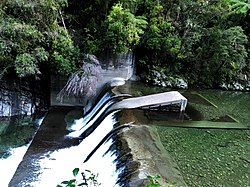
Hutt Water Collection Area is a reserve located in Upper Hutt in the Wellington Region at the southern end of New Zealand's North Island. It is administered by Wellington Regional Council and is located alongside the larger Kaitoke Regional Park.
The park covers 8,900 hectares in the headwaters of Te Awa Kairangi / Hutt River at the southern end of the Tararua Range. The Kaitohe weir is the largest of Wellington Water's three water supply sources, providing between 40 and 50% of the water supply for the Wellington urban area.
4.6 km
The Little Akatarawa River is a river of the Wellington Region of New Zealand's North Island. It is a tributary of the Akatarawa River, which it meets 5 kilometres northwest of Te Mārua.

5.3 km
Karapoti Gorge is one of the entrances into the Akatarawa Forest, a regional park in the Wellington Region in New Zealand. The Akatarawa River West runs through this narrow, mostly bush-clad gorge towards the Akatarawa Valley. A narrow road winds its way along the steep slopes, providing access for trail biking, mountain biking and walking. Karapoti Gorge is also the starting leg of the annual Karapoti Classic mountain bike event, which runs on the network of tracks in the Akatarawa Forest.

5.8 km
The Akatarawa Valley is a valley in the Tararua Range of New Zealand's North Island. It provides a link from the upper reaches of the Hutt Valley to Waikanae on the Kāpiti Coast through rugged hill country. The valley is lowly populated and contains the localities of Reikorangi and Cloustonville. At the Hutt Valley end, the Akatarawa Valley is rugged and the Akatarawa River flows through it. The terrain is less difficult at the Kapiti end, where the Waikanae River flows through part of the valley on its route from its headwaters in the Tararuas to the Tasman Sea, and is met in the valley by tributaries such as the Ngatiawa River and the Reikorangi Stream.
Many residents are craftspeople or gardeners, and some gardens are open for public viewing. Also located in the valley is a former Salvation Army youth and family camp that has been upgraded and now operated by the Wellesley Group, and Staglands Wildlife Reserve & Cafe, a conservation project established in 1972. It supports many native and rare birds, insects, and animals in conjunction with the New Zealand Department of Conservation.
An early proposal for the North Island Main Trunk Railway's route out of Wellington featured a line deviating from the Hutt Valley Line portion of the Wairarapa Line and running through the Akatarawa Valley to the west coast; see Haywards–Plimmerton Line. This proposal was considered in the 1870s but abandoned when the Wellington and Manawatu Railway Company chose a route directly out of Wellington via Johnsonville and Porirua. A railway through the Akatarawa Valley has not been seriously considered since this stage, though Price's Bush Tramway and other industrial tramways were built to serve private logging interests. The tramways and mills they served are now closed and little evidence remains of their existence.