

 English
 Français

Bo'ness
Bo'ness — plus exactement Borrowstounness — est une ville côtière située dans les basses terres centrales, les plaines centrales, de l'Écosse. Elle se trouve sur une colline sur la rive sud de l'estuaire du Forth dans la zone du council (secteur) du Falkirk, 16,9 miles (27,2 km) au nord-ouest d'Édimbourg et de 6,7 miles (10,8 km) à l'est de la ville Falkirk. Au recensement de 2001, la ville avait une population résidente de 13,961, mais selon une estimation de 2008 qui a depuis grimpé à 14.490.
Nearby Places View Menu

295 m
Newtown Park, Bo'ness
Newtown Park is a football ground in Bo'ness, Scotland. It is currently the home ground of both Lowland League side Bo'ness United and East of Scotland League Premier Division club Bo'ness Athletic, and was previously the home ground of Bo'ness.
405 m
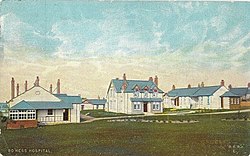
Bo'ness Hospital
Bo'ness Hospital is a community hospital in Dean Road, Bo'ness, Scotland. It is managed by NHS Forth Valley.

543 m
Bo'ness Town Hall
Bo'ness Town Hall is a municipal building in Stewart Avenue, Bo'ness, Scotland. The structure, which was the meeting place of Bo'ness Burgh Council, is a Category B listed building.

565 m
Bo'ness Academy
Bo'ness Academy (BA) is a mixed secondary school in Bo'ness, Falkirk, Scotland. The headteacher is Catriona Reid, who was appointed in 2020.
671 m
Bo'ness
Borrowstounness, commonly known as Bo'ness ( boh-NESS), is a town and former burgh and seaport on the south bank of the Firth of Forth in the Central Lowlands of Scotland. Historically part of the county of West Lothian, it now lies within the Falkirk council area, 17 miles (27 kilometres) northwest of Edinburgh and 6+3⁄4 miles (11 kilometres) east of Falkirk. At the 2011 census, the population of Bo'ness was 15,100.
Until the 20th century, Bo'ness was the site of various industrial activities, including coal mining, saltmaking and pottery production. With its location beside the Forth, the town and its harbour grew in importance in the Industrial Revolution and later continued to grow into the Victorian era. Since the late 20th century, deindustrialisation has changed the nature of the town, with the coal mine closing in 1982 and the waterfront area now being primarily used for leisure purposes. However, some industry remains in the town including an ironworks and a timberyard/sawmill beside the Forth. The centre of the town contains several listed buildings and is part of a conservation area. The town is the home of the Museum of Scottish Railways and also a regional motor museum.