

 English
 Français
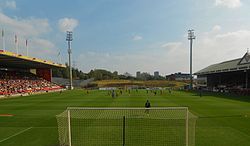
Firhill Stadium
Firhill Stadium est un stade de football et de rugby à XV situé à Glasgow, en Écosse. Ce stade accueille le Partick Thistle FC qui y joue ses matches à domicile depuis 1908 et les Glasgow Warriors, franchise qui dispute la H Cup et la Ligue Celtique, de 2005 à 2012.
Nearby Places View Menu

22 m
Firhill Stadium
Firhill Stadium, also known as Wyre Stadium at Firhill for sponsorship reasons, is a football and former rugby union, rugby league and greyhound racing stadium located in the Maryhill area of Glasgow, Scotland which has been the home of Partick Thistle since 1909.
Past ground-sharing agreements have seen Firhill act as a temporary home for three other football clubs: Clyde, Hamilton Academical and Queen's Park. It was also a venue for the 2000 Rugby League World Cup and the Glasgow Warriors rugby union team between 2007 and 2012. As of 2014, the all-seated capacity of Firhill is 10,102.

188 m
Queen's Cross Church, Glasgow
Queen's Cross Church is a former Church of Scotland parish church in Glasgow, Scotland. It is the only church designed by Charles Rennie Mackintosh to have been built; hence, it is also known as The Mackintosh Church.

440 m
Ruchill Park
Ruchill Park is a public park in Ruchill, Glasgow, Scotland, approximately 2 miles (3 km) north-west of the city centre. It is adjacent to the former location of Ruchill Hospital on Bilsland Drive.

561 m
North Kelvinside
North Kelvinside (also referred to as North Kelvin, Scottish Gaelic: Cealbhainn a Tuath) is a residential district of the Scottish city of Glasgow.
It is often regarded as a subdistrict of Maryhill, sharing its G20 postcode, as well as its House of Commons electoral constituency prior to incorporation into Glasgow North in 2005. However, North Kelvinside was never a part of Maryhill Police Burgh prior to its incorporation into Glasgow in 1912 and the area is markedly different socially and architecturally.
North Kelvinside was originally part of a country estate, which became enveloped by the surrounding city. As a result, many buildings date from the early twentieth century. It is located on the northern edge of Glasgow's west end and its southern boundary is marked by the River Kelvin. It is close to the Glasgow Botanic Gardens, the former BBC Scotland building on Queen Margaret Drive, and in the vicinity of the University of Glasgow, although all are actually outwith the North Kelvinside area itself. Being close to the university, many students and academics live in the area.
Kelvinside House was the property of Lord Provost Sir James Campbell, and was located in the area that is now North Kelvinside. It was there that his son, the future Prime Minister Sir Henry Campbell-Bannerman was born 1836.
North Kelvinside is not directly north of the more upmarket area Kelvinside, which is mainly located to the west. Rather, the area is so named because it is located on the north bank of the River Kelvin. The housing consists mainly of tenements, although there are also some grander villa-type buildings, converted Victorian townhouses, pre-industrial cottages and a small, well-maintained (now mainly ex-)council estate. The area has a reputation for being quiet and tranquil, despite its central location. Unusually, it is impossible to fully traverse the district by car in any direction, due in part to a system of road-blocks designed to combat ratrunning.
Architecturally significant buildings in the area include the Kelvin Stevenson Memorial Church (by J. J. Stevenson, 1898); Gillespie, Kidd & Coia's St. Charles Parish Church (1959), noted for its hyperbolic paraboloid concrete roof and Stations of the Cross sculptures by Benno Schotz; and the unique Mackintosh Church at Queen's Cross, the only church designed by Charles Rennie Mackintosh. Another local landmark is Alexander "Greek" Thomson's Sixty Steps (1872). Contemporary published sources suggest that the steps, associated retaining wall and the original Queen Margaret Bridge were actually part of John E. Walker's co-ordinated civil engineering works of 1869/1870 to the designs of Ritchie Rodger C.E. in preparation for the development of the suburb.
North Kelvinside also contains the former pub where the 'balcony scene' in the film Trainspotting was shot, the Kelvin walkway along the banks of the eponymous river, linking Kelvingrove Park and the Botanic Gardens, and a row of small independent shops and cafes. Outdoor amenities include the North Kelvin Meadow and the Children's Wood which form local green spaces. Scotland's oldest dedicated squash club since 1934, SSRC (Scottish Squash and Racketball Club), is to be found on Malloch Street a short distance from Queen Margaret Drive, with connections going back to the military presence at the barracks that are now Wyndford. The area is also within walking distance of the shops, pubs and restaurants on Great Western and Byres Roads.
Famous current or former residents include former Prime Minister Sir Henry Campbell-Bannerman, the nurse Louisa Jordan, the actor Robbie Coltrane, the comedian Stanley Baxter, director Lynne Ramsay, screenwriter and playwright Peter McDougall, members of the rock band Teenage Fanclub, TV interior designers Justin Ryan and Colin McAllister, YouTube sensation Rombodog, Ian Davidson MP and former Maryhill MP, Maria Fyfe.
There was a North Kelvinside Secondary School that served most of the Maryhill district of Glasgow. However, the school was closed and the vast majority of the pupils transferred to Cleveden Secondary School in the Kelvindale area on the other side of the River Kelvin to the west. Former pupils include actor Robert Carlyle and musician Jimmy Somerville as well as Janis Sharp; mother of Gary McKinnon.
The area is served by North Kelvinside Parish Church, a Church of Scotland congregation which was made famous after World War II, by the work and writing of its minister Rev Tom Allan, particularly his book The Face of My Parish. However, in recent years, the church building was demolished, leaving only the halls which are now in poor condition. The congregation has also been in sharp decline and is currently uniting with the nearby Ruchill Parish Church.
Just south of the area is Hillhead, which forms the heart of Glasgow's West End, and to the north is Maryhill. To the west are Kelvindale and Kelvinside, and to the east Firhill and Woodside.
The district, along with Firhill and Murano Street Student Village, is served by North Kelvin Community Council.
566 m
Hamiltonhill
Hamiltonhill is a residential neighbourhood in the Scottish city of Glasgow, situated between Possilpark to the north and east and Port Dundas to the south. To the west of Hamiltonhill is a nature reserve bordering the Forth and Clyde Canal's Glasgow Branch section (with Firhill Stadium on the opposite bank). The neighbourhood falls under the Canal ward of Glasgow City Council.
The area consisted primarily of Rehousing (low build quality) grey reconstituted stone tenements from the 1930s. Many of these blocks were refurbished in the 1990s, but by the 2010s almost all had been demolished along with the local schools (St Cuthbert's Primary, which was relocated in 2012 to a new facility in Ruchill Park, closer to parts of the district where new homes had already been built) and Wester Common Primary. Another new school complex for children residing locally, 'Keppoch Campus', was also constructed on the eastern side of Possilpark in the 2000s. Some cottage flats dating from the same period as the tenements were retained, with the result that several clusters of surviving homes in Hamiltonhill were surrounded by expanses of empty waste ground in every direction.
In 2018, the local Queens Cross Housing Association published a renewal masterplan for the area involving over 600 new homes.