

 English
 Français
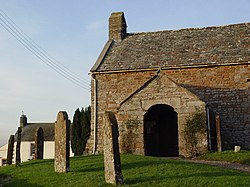
Clifton (Cumbria)
Clifton est un village et une paroisse civile de Cumbria, situé dans le nord-ouest de l'Angleterre.
Nearby Places View Menu
0 m
Clifton, Cumbria
Clifton is a small linear village and civil parish in Cumbria, England. Historically part of Westmorland, it lies 3 miles (4.8 km) south east of Penrith.

642 m
Clifton Moor Skirmish
The Clifton Moor Skirmish (also referred to as the Battle of Clifton Moor or Clifton Moor Action) took place on the evening of Wednesday 18 December during the Jacobite rising of 1745. Following the decision of the council of Charles Edward Stuart to retreat from Derby on 6 December, the fast-moving Jacobite army split into three smaller columns; on the morning of 18th, a small force of dragoons led by Cumberland and Sir Philip Honywood made contact with the Jacobite rearguard, at that point commanded by Lord George Murray.
Murray ordered his baggage train to continue its retreat towards Penrith while he delayed Cumberland's force. The action did not begin until late afternoon, in failing light and heavy rain; while technically a draw, it enabled Murray to retreat in good order and escape into Scotland.
The battle is considered to be one of the last battles on British soil.

681 m
River Lowther
The River Lowther is a small river which flows through limestone rock in Cumbria, England. It is a tributary of the River Eamont which in turn is a tributary of the River Eden which flows into the Solway Firth near Carlisle. The Lowther begins with the confluence of the Keld Gill and the Keld Dub near the village of Keld. It flows north-west until it passes between Bampton and Bampton Grange, before turning north until it flows into the River Eamont close to Penrith.
It is the main spawning area for Eden spring salmon, but is primarily a trout fishery. The river is held back by the Wet Sleddale dam, and so flows at a fairly consistent level (between 0.33 m and 1.8 m for 90% of monitoring time), with the highest level ever recorded at the River Lowther (2.93 m) occurring at Eamont Bridge, Beehive, on Sunday 6 December 2015.
Its name is recorded about 1175 as Lauder. It may come from Brittonic lǭwadr, "a washing or bathing place", which would give it the same etymology as Lauder, Scotland. Alternatively, it may come from Old Norse lauðr + á, meaning "foamy river".

686 m
Clifton Hall, Cumbria
Clifton Hall was a fortified manor house in the village of Clifton, Cumbria. Dating from around 1400, it was constructed by either Elianor Engaine or her son-in-law William Wybergh, and was held by the Wybergh family until the 19th century. Initially taking the form of an "H"-plan design built around a central hall, around 1500 a three-storey stone pele tower was added, providing both additional security and acting as a status symbol for the family. At the start of the 17th century a new stone hall was added to the south of the tower.
The Wyberghs were able to retain Clifton Hall, despite the challenges of the English Civil War, but the house was caught up in the Jacobite risings of 1715 and 1745. In the early 19th century most of Clifton Hall was pulled down to make way for a new farmhouse, and only the pele tower survived. In the 21st century the tower is in the care of English Heritage and operates as a tourist attraction.

852 m
Clifton Moor railway station
Clifton Moor railway station was situated in England on the Eden Valley Railway between Penrith and Kirkby Stephen East. It served the village of Clifton. The station opened to passenger traffic on 1 August 1863, and was originally named 'Clifton'. The 'Moor' suffix was added on 1 September 1927. The station finally closed on 22 January 1962.
On one of the station's platforms a private waiting room was built for the "Yellow Earl of Lonsdale" who lived at nearby Lowther Castle.
To the west of the station was Eden Valley Junction where the Eden Valley Railway joined the Lancaster and Carlisle Railway (now part of the West Coast Main Line), south of the junction was at one time Clifton and Lowther railway station.