


La cathédrale de Livourne (en italien :Cattedrale di San Francesco) est une église catholique romaine de Livourne, en Italie. Il s'agit de la cathédrale du diocèse de Livourne.
Gallery


Sponsored
Location
1 explorer visited this place

169 m
The Old Synagogue of Livorno, or Great Synagogue of Livorno, was a Jewish congregation and synagogue, that was located at Piazza Benamozegh 1, in Livorno, in Tuscany, Italy. The synagogue was completed in 1603 and was devastated during World War II by Nazis in 1944.
The New Synagogue of Livorno was completed in 1962 to replace the former ancient synagogue.

169 m
The New Synagogue of Livorno, or Great Synagogue of Livorno, is a Jewish congregation and synagogue, that is located at Piazza Benamozegh 1, in Livorno, in Tuscany, Italy. Designed in the Modernist style, the synagogue was completed in 1962.
The synagogue replaced the Old Synagogue of Livorno, completed in 1603 and devastated by Nazis in 1944.
178 m
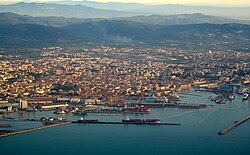
Livorno is a port city on the Ligurian Sea on the western coast of the Tuscany region of Italy. It is the capital of the Province of Livorno, having a population of 152,916 residents as of 2025. It is traditionally known in English as Leghorn.
During the Renaissance, Livorno was designed as an "ideal town". Developing considerably from the second half of the 16th century by the will of the House of Medici, Livorno was an important free port. Its intense commercial activity was largely dominated by foreign traders. Also the seat of consulates and shipping companies, it became the main port-city of the Grand Duchy of Tuscany. The high status of a multiethnic and multicultural Livorno lasted until the second half of the nineteenth century, when it was surpassed by other cities. Evidence of that prosperous time can be seen in the many churches, villas, and palaces of the city.
Livorno is considered to be the most modern among all the Tuscan cities, and is the third most-populous of the region, after Florence and Prato.

246 m
San Giovanni Battista is a Baroque-Mannerist style, Roman Catholic church located at the crossing of Via San Giovanni and Via Carraia in central Livorno, region of Tuscany, Italy.

325 m
The former Caffè Bardi was a notable coffee house and meeting place in the 19th through mid-20th century for artists and intellectuals in Livorno, a region of Tuscany, Italy. The coffee-house no longer exists and stood at the corner of via Cairoli and Piazza Cavour.
In Florence, Caffè Michelangiolo had played a role as a meeting place for painter of the Macchiaioli movement; in Livorno, in the first decades of the twentieth century, this coffee house played the equivalent role of the development of a local group of painters known as the Gruppo Labronico.
Founded in 1908 by Ugo Bardi, the interiors of the coffee house were once populated by contemporary artworks, including works by Gino Romiti and Renato Natali since removed. One of the frequent early attendees was Amedeo Modigliani. There is a legend that Modigliani once brought one of his avant-garde sculptures to show to his friends, but their dislike caused him to bury them in a nearby ditch. The coffee house closed in 1921. Amedeo Modigliani probably attended the establishment during his trips to Livorno in 1909 and 1913.