


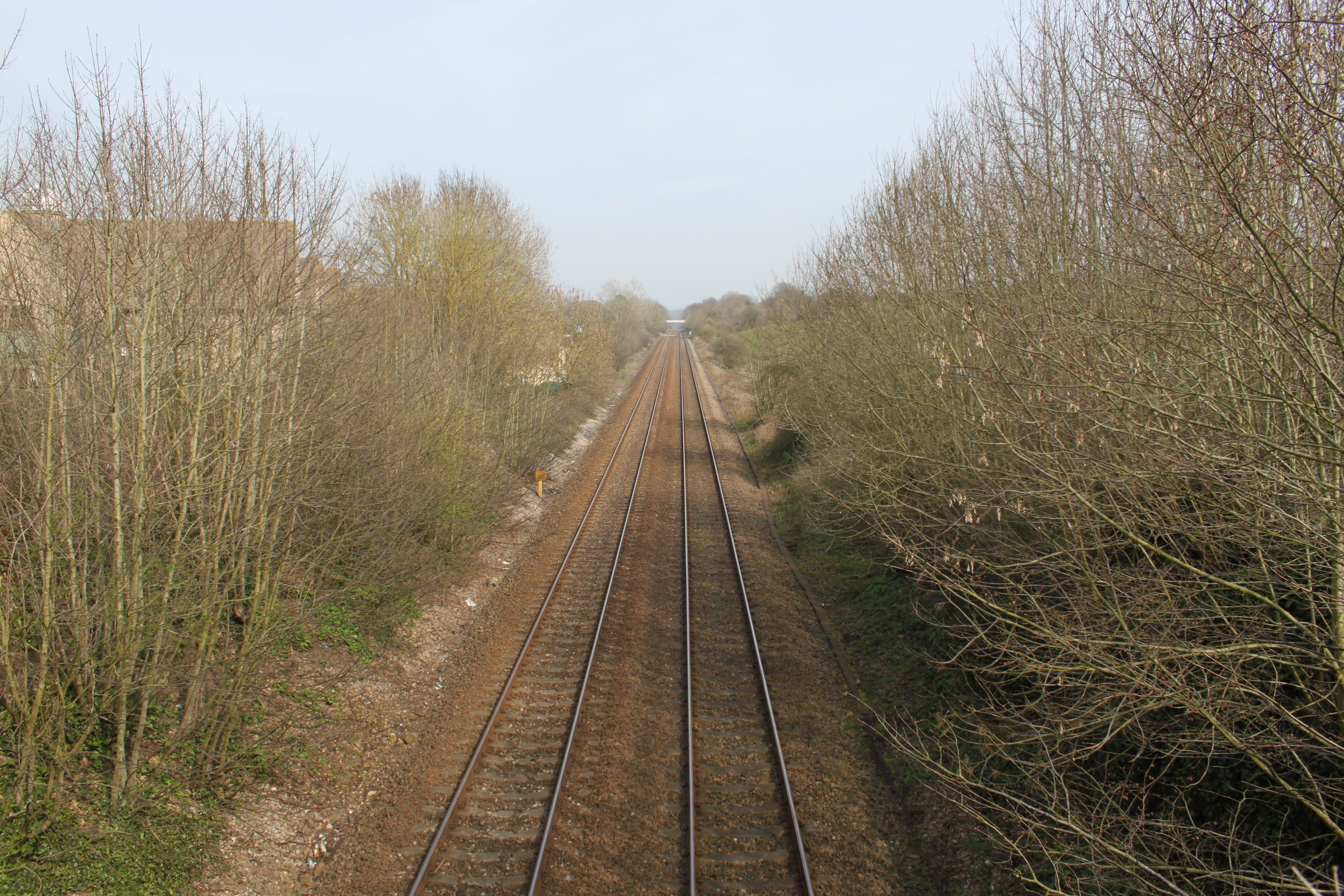
Bruton Railway Cutting is a 1.7 hectare geological Site of Special Scientific Interest at Bruton in Somerset, notified in 1971. The geology exposed in the area near Bruton station (which opened in 1856 on what is now the Heart of Wessex Line) is from the Bathonian epoch of the Middle Jurassic.
Location
1 explorer visited this place

19 m
Bruton railway station serves a largely rural area in the county of Somerset in England. The station is situated in the market town of Bruton. The station is on the Bristol to Weymouth line some 32.75 miles south of Bath Spa. Trains on the Reading to Taunton line pass through the station but do not normally stop. Services are operated by Great Western Railway and South Western Railway.

351 m
Bruton Abbey in Bruton, Somerset was founded as a house of Augustinian canons in about 1127, and became an abbey in 1511, shortly before its dissolution in 1539. It was endowed with manors, churches and other properties in the area and also in Normandy in France.

364 m
The Church of St Mary in Bruton, Somerset, England was largely built in the 14th century. Like many Somerset churches, it has a very fine tower; less usually it has a second one as well. Simon Jenkins has called Bruton's tower "Somerset architecture at its most powerful." It has been designated a Grade I listed building.

446 m
Bruton is a small market town, and civil parish in Somerset, England, on the River Brue and the A359 between Frome and Yeovil. It is 7 miles south-east of Shepton Mallet, just south of Snakelake Hill and Coombe Hill, 10 miles north-west of Gillingham and 12 miles south-west of Frome. The town and ward have a population of 2,907. The parish includes the hamlets of Wyke Champflower and Redlynch.
Bruton has a museum of items from the Jurassic period onwards. It includes a table used by the author John Steinbeck on a six-month stay.
The Brue is flood-prone – in 1768 it wrecked a stone bridge. The 242.8 mm of rain that fell on 28 June 1917 left a river watermark on a pub wall 20 feet above the mean. In 1984 a protective dam was built upstream.
533 m
King's Bruton is an independent HMC co-educational boarding and day school in the English public school tradition located in Bruton, Somerset. It was founded in 1519 by Richard FitzJames, making it one of the oldest schools in the United Kingdom and since the Dissolution of the Monasteries, has been in continuous operation for over 470 years. In 1550 the school received royal foundation status during the reign of Edward VI.
The citation for the site describes it as one of the best places in England to demonstrate the stratigraphic distinction of ammonites in the subcontractus zone and the morrisi zone.
See also
Wookey Station Godminster Lane Quarry and Railway Cutting
