

 English
 Français

Beinn a' Chòin
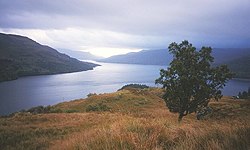
Beinn a' Choin (769 m) is a mountain in the Grampian Mountains of Scotland. It lies on the border of the Stirling region and Argyll at the northern end of Loch Lomond. A rugged and wild mountain of rocks and moorland lying north of Ben Lomond, it usually climbed from the small settlement of Inversnaid.
Nearby Places View Menu

2.3 km
Island I Vow
Island I Vow is a wooded islet near the head of Loch Lomond in west-central Scotland. It is 10 m tall at its highest point, and 80 m long. The island contains the remains of a castle built by the chief of Clan MacFarlane in 1577. This became the chief's primary residence after the destruction of Inveruglas Castle further down the loch, but it fell into ruin after the chief moved to the mainland.
The island's name appears as Elan(a)vow in older sources and seemingly means "island of the booth or store", from the Gaelic eilean a' bhùtha. Alternatively, the second element may be bhodha, meaning "sunken rock".

4.0 km
Creag-an-Arnain Viaduct
The Creag-an-Arnain Viaduct is a railway viaduct that carries the West Highland Line.

4.4 km
Inversnaid
Inversnaid (Scottish Gaelic: Inbhir Snàthaid) is a small rural community on the east bank of Loch Lomond in Scotland, near the north end of the loch. It has a pier and a hotel, and the West Highland Way passes through the area. A small passenger ferry runs from Inversnaid to Inveruglas on the opposite shore of the loch, and also to Tarbet. There is a seasonal ferry that also operates between Ardlui and Ardleish as well, which is a walkable distance from Inversnaid. To reach Inversnaid by road involves a 15-mile (24-kilometre) route from Aberfoyle. Nearby is an alleged hideout of Rob Roy MacGregor known as Rob Roy's Cave. The cave is difficult to access, and is best seen from Loch Lomond, where there is white paint indicating the location of the hideout.
4.4 km
Loch Lomond and The Trossachs National Park
Loch Lomond and The Trossachs National Park (Scottish Gaelic: Pàirc Nàiseanta Loch Laomainn is nan Tròisichean) is a national park in Scotland centred on Loch Lomond and the hills and glens of the Trossachs, along with several other ranges of hills. It was the first of the two national parks established by the Scottish Parliament in 2002, the second being the Cairngorms National Park. The park extends to cover much of the western part of the southern highlands, lying to the north of the Glasgow conurbation, and contains many mountains and lochs. It is the fourth-largest national park in the British Isles, with a total area of 1,865 km2 (720 sq mi) and a boundary of some 350 km (220 mi) in length. It features 21 Munros (including Ben Lomond, Ben Lui, Beinn Challuim, Ben More and two peaks called Ben Vorlich) and 20 Corbetts.
The park straddles the Highland Boundary Fault, which divides it into two distinct regions - lowland and highland - that differ in underlying geology, soil types and topography. The change in rock type can most clearly be seen at Loch Lomond itself, as the fault runs across the islands of Inchmurrin, Creinch, Torrinch and Inchcailloch and over the ridge of Conic Hill. To the south lie green fields and cultivated land; to the north, mountains.
The Loch Lomond and The Trossachs National Park lies close to Scotland's heavily populated Central Belt, and the area has long been popular with visitors. Principal attractions are viewing scenery and wildlife, walking, climbing, water sports, and other outdoor activities. In 2017, there were 2.9 million visits to the park, of which 2.1 million were day visits and 783,000 were made by visitors staying overnight within the park.