


Moorhead High School is a public high school in Moorhead, Minnesota, United States. Established in 1883, the school serves approximately 2,000 students in grades 9–12. The school has a student-teacher ratio of 18.81.
Location
1 explorer visited this place

1.5 km
Minnesota State University Moorhead is a public university in Moorhead, Minnesota, United States. It has an enrollment of 4,679 students as of 2023 and 266 full-time faculty members. MSUM is a part of the Minnesota State Colleges and Universities system.
1.8 km
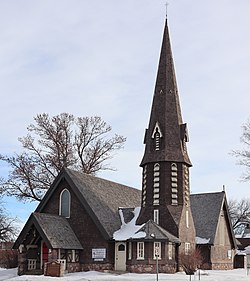
St. John the Divine Episcopal Church, also known as St. John's Episcopal Church, is a church in Moorhead, Minnesota, United States. It was built 1898–99 in Shingle Style and is considered Moorhead's leading architectural landmark and one of Cass Gilbert's most interesting churches. It was listed on the National Register of Historic Places in 1980.
Unlike all other episcopal churches in Minnesota, it is part of the Episcopal Diocese of North Dakota because of its proximity to Fargo.
Its design was the basis for design of St. George's Episcopal Memorial Church in Bismarck, North Dakota, which was completed in 1949 and was listed on the National Register in 2021.

1.8 km
Moorhead is a city in and the county seat of Clay County, Minnesota, United States, on the banks of the Red River of the North. Located in the Red River Valley, an extremely fertile and active agricultural region, Moorhead is home to several corporations and manufacturing industries. Across the river from Fargo, North Dakota and next to Dilworth, Minnesota, Moorhead forms part of the core of the Fargo–Moorhead ND-MN Metropolitan Area. The population was 44,505 at the 2020 census. Moorhead is a hub of higher education in Minnesota, home to Minnesota State University Moorhead, Concordia College, and a campus of Minnesota State Community and Technical College.
Platted in 1871, the city was named for William Galloway Moorhead, an official of the Northern Pacific Railway.
1.9 km
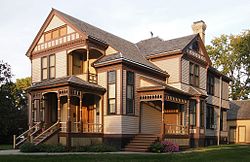
The Comstock House is a historic house museum in Moorhead, Minnesota, United States. It was built for Solomon Comstock and his family from 1882 to 1883 in a mix of Queen Anne and Eastlake style. Comstock was one of Moorhead's first settlers and an influential figure in business, politics, civics, and education in the growing city and state.
The Comstock House is run by a partnership between the Minnesota Historical Society and the Historical and Cultural Society of Clay County. It was listed on the National Register of Historic Places in 1974 as the Solomon Gilman Comstock House for its state-level significance in the themes of architecture, commerce, education, exploration/settlement, industry, politics/government, and transportation. It was nominated for its association with Solomon Comstock, who was instrumental in growing Moorhead from a pioneer village to a "booming railroad town", and for its exemplary late Victorian architecture.

1.9 km
Prairie Home Cemetery is the oldest cemetery in Moorhead, Minnesota.
The cemetery was founded in 1875 by the Rev. Oscar Elmer, a Presbyterian minister who was the first ordained member of Christian clergy in Fargo–Moorhead. Rev. Elmer's brother John had drowned in the Red River of the North while visiting from New York in 1874. The condition of John Elmer's body when it was recovered meant that it could not be shipped back East, as was the usual custom, but had to be buried immediately in a makeshift grave. The following spring, Rev. Elmer organized a cemetery association, which formally created the Prairie Home Cemetery. John Elmer's body was then moved to the new cemetery.
The cemetery is still in operation. However, by 1929 the Prairie Home Cemetery Association merged with the Riverside Cemetery Association, which had organized a cemetery across the Red River in Fargo, North Dakota in 1884.
Garrison Keillor used the cemetery's name for the title of his long-running radio program A Prairie Home Companion.