


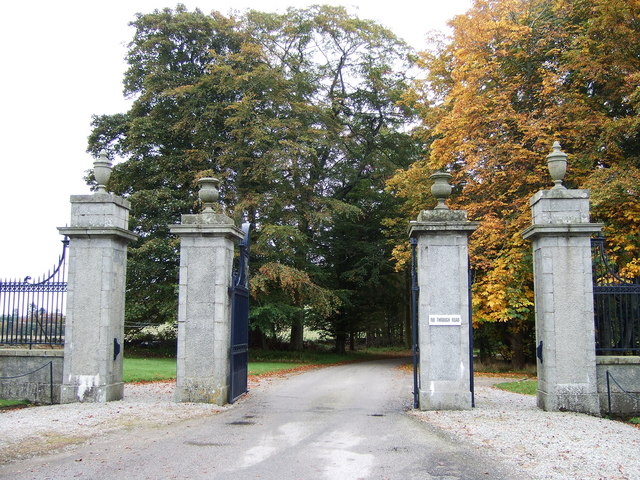
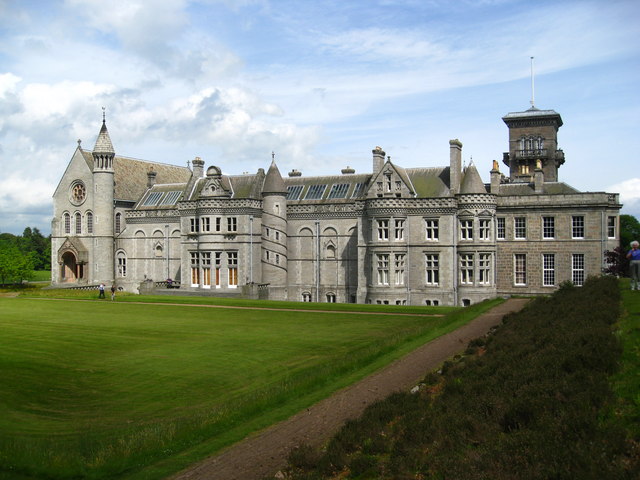
Dunecht House is a stately home on the Dunecht estate in Aberdeenshire, Scotland. The house is protected as a category A listed building, and the grounds are included on the Inventory of Gardens and Designed Landscapes in Scotland, the national listing of significant gardens.
Gallery




Sponsored
Location
23 m
The Dunecht Estate is one of the largest private estates in Aberdeenshire, Scotland at 53,000 acres. It is owned by The Hon Charles Anthony Pearson, the younger son of the 3rd Viscount Cowdray. Dunecht's business interests include farming, forestry, field sports, minerals, let houses, commercial lets and tourism.
The main part of the estate lies between Banchory and Westhill, encompassing the village of Dunecht, the Loch of Skene and the stately home of Dunecht House. The estate grounds include a golf course and extensive areas of forestry and farming.
The estate also includes separate areas of land at Birse and Durris on Royal Deeside, Edinglassie in Strathdon and Dunnottar Castle near Stonehaven.

1.1 km
Dunecht is a slightly linear village on the A944 road in north-east Aberdeenshire in Scotland. It is not to be confused with Echt.
Dunecht is located 12 miles west of the city of Aberdeen and is situated by the confluence of the Kinnernie and Bervie burns.
Formerly known as Waterton, it was renamed to Dunecht in the 1820s when the Crawford family built Dunecht House. The estate achieved a certain measure of notoriety in 1881 due to theft of the remains of the Alexander Lindsay, 25th Earl of Crawford.
Dunecht House, once owned by Viscount Cowdray is now privately owned. Dunecht House is to the south of the village and was once famed for its observatory, ballroom and library, as well as gardens which were opened once a year to the public. The estate is also home to the Dunecht Cricket Club, founded as an estate cricket club in 1925 and still actively playing in the Aberdeenshire Grades cricket league.
Corsindae House is 5 miles west of here, and is in the Scottish baronial style; built between the 1450s and 1600s.
Amenities in the village include a school, a pub, and a garage-come-shop.

2.6 km
Echt is a crossroads village in Aberdeenshire, Scotland. Echt has a number of prehistoric remains, including the Barmekin of Echt, a prehistoric hillfort on a hill to the northwest. There is also the Cullerlie stone circle near Sunhoney Farm, which may date from the Bronze Age.
Echt contains a church, a village shop and post office, a restaurant, and a pleasure park with a children's play area. Local football matches are also held there. The annual Echt Show, a farmers' show, is held on the second Saturday in July.
It is centred on the junction of the B977 Dunecht to Banchory road and the B9119 Kingsford to Ordie road. It is some 12+1⁄2 miles from the city of Aberdeen.

3.4 km
Loch of Skene is a large lowland, freshwater loch in Aberdeenshire, Scotland. It lies approximately 1 mi to the west of the village of Kirkton of Skene and 9 mi west of Aberdeen.
The loch is partially man-made, being dammed at its outflow on the southern shore to form a reservoir. Before 1905, water from the loch was used in the making of tweed and to turn the mill wheel at the Garlogie Mills. The mills closed in 1905. From 1923, the water was used to generate electricity. The loch is about 6 foot deep at its deepest.
3.9 km
The Garlogie Beam Engine is a steam powered beam engine, built in 1833, that once powered a woollen mill at Garlogie, Aberdeenshire. It is a rare survivor of the Industrial Revolution and the oldest steam engine of any kind still in its original location in Scotland. It contains what is believed to be the oldest cast iron engine beam in the world, dating from 1805.
Book your tour near
Dunecht House
Book Now
4.4
in partnership with
GetYourGuide.com