

 English
 Français

Hulme Barracks
Hulme Barracks is a former military installation in Hulme, Manchester, England.
Nearby Places View Menu
279 m
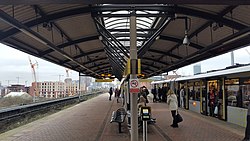
Cornbrook tram stop
Cornbrook tram stop is a tram stop on Greater Manchester's light rail Metrolink system in the Cornbrook area of Manchester, England. It is an interchange station, allowing passenger transfer between the network's Altrincham, Eccles, Airport, Trafford Park and South Manchester lines. The station opened on 6 December 1999 for interchange (line transfers) only and allowed street-level entry and exit to the public from 3 September 2005. It takes its name from Cornbrook Road, between the A56 and Pomona Docks on the Manchester Ship Canal, and was built on what was a Cheshire Lines Committee route to Manchester Central railway station. The stop is one of the most used on the Metrolink network.
301 m
Cornbrook railway station
Cornbrook railway station was opened on the south side of Cornbrook Road in the St. George's area of Manchester on 12 May 1856 by the Manchester South Junction and Altrincham Railway (MSJAR) to serve the nearby Pomona Gardens; there were four trains daily in each direction. It closed on 1 June 1865, the last trains having called on 31 May 1865.

342 m
Hulme Locks Branch Canal
The Hulme Locks Branch Canal is a canal in the city of Manchester. It is 200m (one furlong) in length and was built to provide a direct waterway between the Mersey and Irwell Navigation and the Bridgewater Canal. The canal opened in 1838 and was superseded in 1995 by a new lock at Pomona Dock 3. As both of its locks remain closed, the canal is now overgrown.

535 m
Church of St George, Chester Road, Hulme
The Church of St George, Chester Road, Hulme, Manchester, is an early Gothic Revival church by Francis Goodwin, built in 1826–1828. It was restored in 1884 by J. S. Crowther. It was designated a Grade II* listed building on 3 October 1974.
The church was a Commissioners' church, (built to celebrate the victory at the Battle of Waterloo) allotted the sum of £15,000 for construction. Goodwin was an obvious choice for architects having already undertaken a number of churches in the Midlands and the North West, as well as the original Manchester Town Hall. Sir Nikolaus Pevsner considers that Goodwin's inspiration was Nicholas Hawksmoor's St Michael, Cornhill and that "the whole makes a lively and memorable picture". A six-bay nave with "high three-light Perpendicular windows" concludes with a tall tower at the west end, and two high pinnacles at the east. Porches are set at the northwest and southwest corners.
Drawing from Pevsner, the English Heritage inspectors who listed the building in 1974, without an internal inspection, stated that the interior was "reported as having: galleries; Perpendicular arcades; [and a] wall monument to The Hon. George Berkeley Molyneux (d.1841), by Edward Physick, in form of soldier mourning beside urn."
A declining inner-city population in the post-war period, combined with the increasing isolation of the church caused by major road construction in its vicinity, led to St George's closure in 1984. The last Rector Revd Derek Seber worked with Brian Redhead to try to find a long term use for the building including as a museum for Rolls-Royce and as a Museum of Sport . The transformation into such was planned under the then governments Community Programme which offered training in conservation and building skills. A change in policy brought this initiative to an end. There followed a "twenty-year search for a use which would preserve the interior … proved fruitless and the building was converted to flats (in) 2000–2. The interior can no longer be read as a whole." In 2015, the flat occupying the church tower was on the market for £1 million.