

 English
 Français
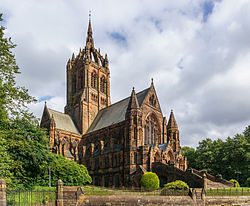
Coats Paisley
Coats Paisley is a reception hall which stands at the west end of the High Street in Paisley, Scotland. The building was the home of Thomas Coats Memorial Baptist Church, colloquially known as the Baptist Cathedral of Europe, until 2018. It has been a dominant feature of the Paisley skyline for over 100 years with its striking crown steeple rising to 60 metres (200 ft) above the ground. The church is a category A listed building.
Nearby Places View Menu

51 m
High Street drill hall, Paisley
The High Street drill hall was a historic building in Paisley, Scotland, built in 1901 for the 2nd Renfrewshire Rifle Volunteers (part of the Argyll and Sutherland Highlanders). The architect was Thomas Graham Abercrombie, who was himself a member of the unit.
The 2nd Renfrewshire Rifle Volunteers were incorporated into the 6th Battalion of the Argyll and Sutherland Highlanders in 1908. The battalion was mobilised at the drill hall in August 1914 before being deployed to the Western Front. The 6th Battalion amalgamated with the 5th Battalion to form the 5th/6th Battalion in 1921.
In latter years the building was used by the Territorial Army. The TA vacated the building in 1996 and it was subsequently sold to the University of the West of Scotland, which in turn sold it to a development company in 2007.
The building was gutted by fire in 2020. In 2024, the owners removed the supports keeping the facade in place, claiming that they had begun to subside. Renfrewshire Council subsequently issued a dangerous building notice requiring them either to replace the supports or to pull the remains of the building down. The owners opted for demolition.

142 m
Paisley Museum and Art Galleries
Paisley Museum and Art Galleries is a museum in Paisley, Scotland. It is currently closed for refurbishment and is due to reopen in 2026 only with the title of Paisley Museum. It is located in the town of Paisley and is run by Renfrewshire Council. When it had art galleries, six in total, it housed one of the largest municipal art collections in Scotland, including over 800 paintings.
The Museum and Art Galleries were gifted to the town of Paisley by the thread-making industrialist Sir Peter Coats in 1871. The building, which also houses Paisley Library and the Coats Observatory, was designed by Glasgow architect John Honeyman of the firm of Honeyman and Keppie. The first curator of the Museum was the entomologist Morris Young who remained in post until his death in 1897 leaving the Museum a bequest of £500 to be invested and the returns used to pay for the upkeep of the entomological collections and all his books. The museum has been extended on several occasions since it opened. In 2017 plans were announced for a revamp of the Museum to transform it into an "international-class destination" based around Paisley's heritage story.
The art collection displayed over many years, including the large art collection owned by Paisley Art Institute has concentrated largely on works by late nineteenth-century and early twentieth-century Scottish artists, such as the Glasgow School and the Scottish Colourists.In addition a contemporary collection was made which includes work by artists such as Steven Campbell and John Byrne, who was born in Paisley.
The museum houses a collection of objects and documents covering the local and international history of Paisley and Renfrewshire, especially the importance of the textiles and thread-making industry, tracing the history of the luxury shawl industry which developed in Paisley. The museum has recreated the work and a weaving using a traditional hand loom can be seen on site It also contains an archaeological collection which includes objects from Ancient Egypt and Babylon and an extensive natural history collection, the museum also houses the local biological records centre.
One of the most important items in the Museum's collection is the Arbuthnott Missal which was presented to the Museum by another of the Coats family, Archibald. This missal is the only extant pre Reformation missal (liturgical book) of the Scottish Use and in 2007 it was awarded a prestigious top award in the British Library's Hidden Treasures Brought to Life competition.
The museum is currently closed to the public. In August 2025 Renfrewshire Council stated that they expected to re-open as Paisley Museum in the second half of 2026.
505 m
Paisley canal disaster
The Paisley Canal Disaster occurred on 10 November 1810 on the Glasgow, Paisley and Johnstone Canal, a canal linking Glasgow to Paisley and Johnstone in Renfrewshire, Scotland.

523 m
Paisley Gilmour Street rail accident
The Paisley Gilmour Street rail accident occurred on 16 April 1979 at 19:50. The 19:40 Inverclyde Line service from Glasgow Central to Wemyss Bay, operated by two Class 303 trains, crossed from the Down Fast Line to the Down Gourock Line under clear signals at Wallneuk Junction immediately to the east of Paisley Gilmour Street railway station. It collided head-on with the 18:58 Ayrshire Coast Line special service from Ayr to Glasgow Central, formed of two Class 126 diesel multiple units, which had left Platform 2 against a red signal P31.