

 English
 Français

West Wemyss
West Wemyss est un village d'Écosse, située dans le council area du Fife et la région de lieutenance du même nom. Il s'est développé autour du château de Wemyss. En 1621, un port est construit pour exporter du charbon, lequel conserve son activité jusqu'à la fin du XIXe siècle lorsque la concurrence devient trop forte. La ville possède une tour de péage du XVIIIe siècle et un presbytère du XIXe siècle.
Nearby Places View Menu

190 m
West Wemyss Tolbooth
West Wemyss Tolbooth is a municipal building in Main Street, West Wemyss, Fife, Scotland. The structure, which is used as commercial offices, is a Category B listed building.
628 m
West Wemyss
West Wemyss ( Scottish Gaelic: Uaimheis an Iar) is a village lying on the north shore of the Firth of Forth, in Fife, Scotland. According to the 2007 population estimate, the village has a population of 237. The village was granted burgh of barony status in 1525, bearing the name from the Wemyss family who lived in Wemyss Castle.
773 m
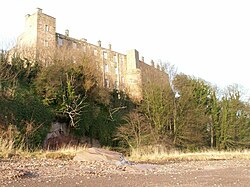
Wemyss Castle
Wemyss Castle (pronounced [weems]) is situated in Wemyss on the sea cliffs between the villages of East Wemyss and West Wemyss in Fife, Scotland. Wemyss Castle is considered to be a multi-period building, and today's castle includes many elements from former periods such as the 15th-century tower and the 19th-century stables and gatepiers.

1.4 km
Coaltown of Wemyss
Coaltown of Wemyss () is a village in south-east Fife, Scotland, around 5 km north of Kirkcaldy. The town was built in the 1890s as an estate village on the lands of nearby Wemyss Castle to house - as the name implies - mineworkers employed in several coal mines in the area. The miners' cottages were designated as a conservation area in 1980. Today the Coaltown has a primary school, some small shops, and the Earl David Hotel, named after David Wemyss, 2nd Earl of Wemyss. Wemyss Castle itself is not open to the public but its gardens can be visited during summer.

1.7 km
Dysart, Fife
Dysart ( ; Scottish Gaelic: Dìseart (IPA:[ˈtʲiːʃəɾʃt̪])) is a town and former royal burgh located on the south-east coast between Kirkcaldy and West Wemyss in Fife, Scotland. Dysart was once part of a wider estate owned by the St Clair or Sinclair family. They were responsible for gaining burgh of barony status for the town towards the end of the 15th century.
The first record of the town was made in the early 13th century, its initial role being to settle civil matters between the church and landowners. During the middle of the 15th century, trade with the Low Countries began for salt and coal exportation. In the 16th and 17th centuries, trade expanded to the Baltic Countries. Dysart acquired two nicknames: "Salt Burgh" and "Little Holland" as a result.
Following the sudden decline of the town's harbour caused by the closure of the Lady Blanche Pit, the town was amalgamated into the royal burgh of Kirkcaldy under an act of parliament in 1930. Urban clearance during the 1950s and 1960s saw large parts of the historic town demolished for new housing. Demand from the town's residents meant that part of the historic town — most notably the 16th-century and the 18th-century houses of Pan Ha' opposite the harbour — were salvaged and preserved for future generations.