


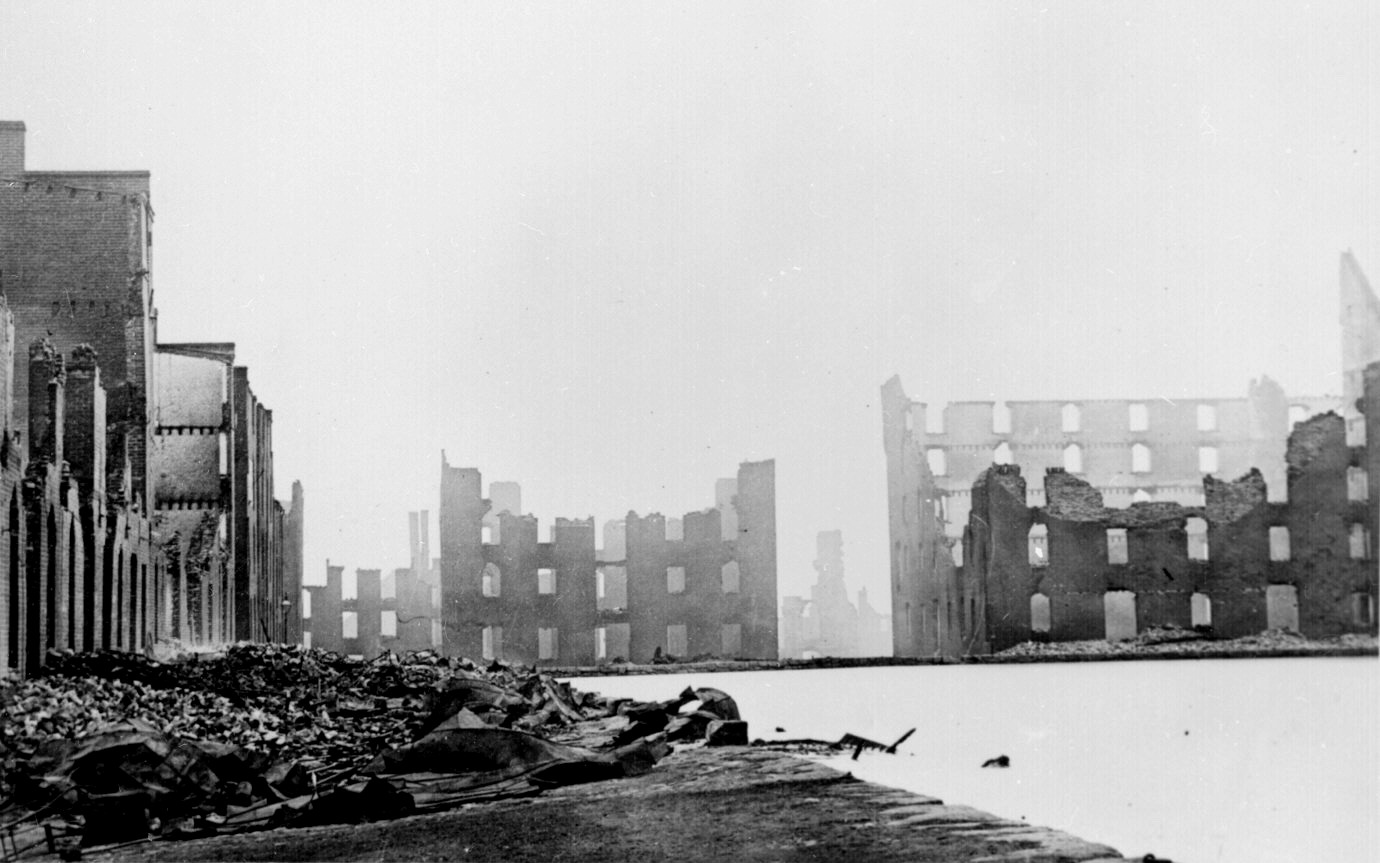
The Gallego Flour Mills was a flour mill located in Richmond, Virginia, United States. Founded by Joseph Gallego in the 1790s, the mill gained international reputation for the superior type of flour that was shipped from there to Europe and South America. Further, the mills became iconic image of the defeated south after Mathew Brady shot a photo of the Mills after much of the city burned in 1865.
Gallery

Sponsored
Location

218 m
Shockoe Slip is a district in the downtown area of Richmond, Virginia. The name "slip" referred to a narrow passageway leading from Main Street to where goods were loaded and unloaded from the former James River and Kanawha Canal. The rough boundaries of Shockoe Slip include 14th Street, Main Street, Canal Street and 12th Street.
Architecturally, many of the buildings in Shockoe Slip were constructed during the rebuilding following the Evacuation Fire of 1865, especially in a commercial variant of the Italianate style. It is centered on a 1909 fountain, dedicated to "one who loved animals." The buildings in the district, which historically housed a variety of offices, wholesale and retail establishments, are now primarily restaurants, shops, offices, and apartments.

222 m
The Southern Railway Depot on 14th Street in Richmond, Virginia, was a passenger station for the Southern Railway that operated from 1900 to 1914. Another name of this depot was Mill Street Station. Previously, the Southern had operated its Richmond passenger service out of an old Richmond and Danville Railroad wooden frame depot that laid about 600 feet south of the 14th Street Depot. This depot had been constructed around 1865–1866 to replace the one built in the early 1850s and burnt in the Fall of Richmond in April 1865. The original R&D depot had been the departure station for the train carrying Confederacy Jefferson Davis and his cabinet to Danville immediately before Richmond fell to the Union Army during the Civil War.
Around the turn of century, the railroad initialized plans to replace the old R&D depot with a new one constructed of brick and granite. They hired architect Frank Pierce Milburn to design it and awarded the contract to Frederick "Fritz" Sitterding. In the railroad journal, The Railway Surgeon, an intricate description is given of the depot:
"The building will be of granite and gray pressed brick, with a green slate roof. it will have a 70-foot frontage on Mill street and 175 feet on Fourteenth street, with a 100-foot tower on the corner. The arrangement of the interior will be simple and convenient, with an entrance through a vestibule on Mill street, and beneath the tower. Ticket offices will be located at the right of the entrance, and at the north end of the waiting room and adjoining the vestibule will be situated the ladies' parlor. At the extreme south end of the waiting room will be a room for colored people, with a hallway between connecting with the baggage and express rooms. The waiting room will be 40 by 50 feet, finished in chestnut, with frescoed walls and ceilings and marble tiling floor."
Construction was finished in 1900. In 1914, the Southern decided to split its passenger services into two stations: one at Main Street Station, a couple blocks away from the 14th Street depot, and another at a new station on Hull Street, appropriately named Hull Street Station. As a result of this split, the 14th Street Depot was demolished and replaced by a freight depot with combined offices. The new freight depot was 40 feet wide and 480 feet long and had offices on the first floor for the first 40 feet and on the second floor for 150 feet. The remaining 440 feet on the first floor was devoted to freight warehouse space. The reason for the demolishment of the 14th Street Passenger depot was that the Southern Railway needed the additional space for freight.
The new 14th Street freight depot continued to serve the Southern until the 1980s when the railroad merged with the Norfolk and Western Railway to create the Norfolk Southern Railway. At this point, most of the freight depot was demolished except for a 166-foot section fronting on what is now Canal Street. This was redeveloped as the Southern Railway Taphouse and is a popular bar and brewery in the present day.

254 m
Richmond Tobacco Exchange was a commodities exchange in Richmond, Virginia, where tobacco was traded.
It was established in 1858. Tobacco farmers opposed its creation, because the exchange was controlled by merchants.
The Richmond Chamber of Commerce reported sales of leaf tobacco through the exchange for the year ended September 30, 1873 were 45,595 hogsheads, 11,415 tierces and 1,814 boxes.
In the year ended September 30, 1872, 2,593,110 pounds of loose tobacco was weighed at warehouses in Richmond, most at the Shockoe Warehouse.

282 m
The James River and Kanawha Canal was a partially built canal in Virginia intended to facilitate shipments of passengers and freight by water between the western counties of Virginia and the coast. Ultimately its towpath became the roadbed for a rail line following the same course.
Encouraged by George Washington, the canal project was begun in 1785 as the James River Company, and later restarted under the James River and Kanawha Canal Company. It was an expensive project which failed several times financially and was frequently damaged by floods. Though largely financed by the Commonwealth of Virginia through the Virginia Board of Public Works, it was only half completed by 1851, reaching Buchanan, in Botetourt County. When work to extend it further west stopped permanently, railroads were overtaking the canal as a far more productive mode of transportation.
After the American Civil War funds for resuming construction were unavailable from either the war-torn Commonwealth or private sources and the project did poorly against railroad competition, finally succumbing to damage done by massive flooding in 1877. In the end its right-of-way was bought and the canal was largely dismantled by the new Richmond and Alleghany Railroad, which laid tracks on the former towpath. The R&A became part of the Chesapeake and Ohio Railway in the 1890s, which developed much of the former canal route into an important line for West Virginia bituminous coal headed eastbound for the Peninsula Extension to reach the Hampton Roads coal piers at Newport News for worldwide export aboard large colliers.

327 m
The Triple Crossing in Richmond, Virginia, is one of two places in North America where three railroad lines cross at different levels at the same spot, the other being the BNSF operated Santa Fe Junction in Kansas City. Santa Fe Junction became a triple crossing after the Argentine Connection was completed in 2004.
At the lowest level, Norfolk Southern Railway operates a line to West Point, Virginia on its Richmond District line. The line was first built by the Richmond and Danville Railroad between 1886 and 1895 and split off from its main line on the north side of the railroad's James River bridge and ran to the eastern end of the peninsula created by the Kanawha Canal. This line was paralleled by an older trestle built by the Richmond and Alleghany Railroad in the early 1880s. The trestle and tracks ran from the R&A yards at Eighth and Canal Streets, along Byrd Street, and ended at the terminus of the peninsula. Between 1895 and 1905, the R&D extended its line across the canal to join with the old Richmond and York River Railroad at a point just to the west of Pear and Dock Streets. The bridge which carried the line across the canal was replaced in 1930 by one built by the Virginia Bridge and Iron Company. After the Civil War, the R&D had built a connection railroad to the R&YR along Dock Street and primarily used this line to route its West Point traffic. However, the Dock Street line was abandoned in the late 1980s, upon which all traffic was routed to the line lying on the south of the canal.
The middle level was formerly the main line of the Seaboard Air Line Railroad and is now part of CSX Transportation's "S" line. The 18-foot-high trestle was built between 1897 and 1900 as part of the Richmond, Petersburg and Carolina Railroad, which was bought by the SAL in 1898. About 1,000 feet north of the Triple Crossing lies Main Street Station, which was jointly operated by the SAL and the Chesapeake and Ohio Railway. This line is planned to become part of the Southeast High Speed Rail Corridor.
At the top level is the 36-foot-high Peninsula Subdivision Trestle, a 3-mile-long viaduct parallel to the north bank of the James River built by the Chesapeake and Ohio in 1901 to link the former Richmond and Alleghany Railroad with the C&O's Peninsula Subdivision to Newport News and export coal piers. The viaduct, now owned by CSX Transportation, provided an alternate path to the notoriously unstable Church Hill Tunnel which was used from 1873 to 1925 and buried a work train with fatalities on October 2, 1925. A locomotive and ten flat cars remain entombed with at least one rail worker, killing several others whose bodies were eventually recovered.
The triple crossing has been a Richmond attraction for railfans for over 100 years, although the number of photographic angles decreased in the 1990s due to a new flood wall. The three railroads intersecting at Triple Crossing staged photos with trains on all three levels on several occasions.
At the time of their destruction, they were the largest of their kind in the world.