

 English
 Français

Staithes railway station
Staithes railway station was a railway station on the Whitby Redcar and Middlesbrough Union Railway, serving the villages of Staithes and Dalehouse in North Yorkshire, England. It was opened on 3 December 1883.
Nearby Places View Menu

22 m
Staithes
Staithes (locally /'stɪəz/) is a village in North Yorkshire, England, situated by the border between the unitary authorities of North Yorkshire and Redcar and Cleveland. The area located on the Redcar and Cleveland side is known as Cowbar. Formerly a hub for fishing and mining, Staithes is now a tourist destination in the North York Moors National Park.
It is in the civil parish of Hinderwell. From 1974 to 2023 it was part of the Borough of Scarborough, it is now administered by the unitary North Yorkshire Council.
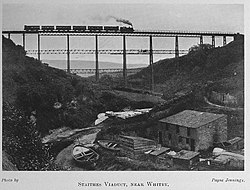
151 m
Staithes Viaduct
Staithes Viaduct was a railway bridge that straddled Staithes Beck at Staithes, Yorkshire, England. It was north of the closed Staithes railway station. It was known for an anemometer, a fitting to tell the signaller if winds across the viaduct were too strong for crossing trains.
Major crossing structures, including the viaduct, on the Whitby to Loftus line were made out of iron, with the piers additionally filled with concrete. The viaduct started to be built in 1875 and opened in 1883 – due to financial, build and ownership problems. The line closed in 1958 and the viaduct demolished in 1960.

171 m
Our Lady Star of the Sea Church, Staithes
Our Lady Star of the Sea is a Catholic church in Staithes, a village in North Yorkshire, in England.
Until the late 19th century, Catholics in Staithes worshipped at Ugthorpe or at Loftus. A church was constructed between 1884 and 1885, to a design by Martin Carr, in the Gothic Revival style. It cost about £1,250, and the first resident priest was installed in 1895.
The church is built of sandstone and has a Welsh slate roof. It is a single space with a combined nave and chancel, measuring 70 feet (21 m) by 25 feet (7.6 m). There is a porch at the west end, below a statue of the Virgin and Child on the prow of a boat, carved by A. B. Wall. Above them is a circular window, and a gable end topped by a large bellcote. Nikolaus Pevsner was unimpressed by the bellcote and described it as "fussy". The windows are lancets, quite poorly carved. There is a presbytery attached to the southeast corner of the church, which may be contemporary or slightly later. Inside are a Gothic altar and pulpit, original pews, and one stained glass window installed in about 1973.

331 m
Primitive Methodist Chapel, Staithes
The Primitive Methodist Chapel is a historic building in Staithes, a village in North Yorkshire, in England.
Primitive Methodism first reached Staithes in the 1820s, and a chapel was completed in 1858. However, it soon proved too small, and a new chapel was built next door in 1880. The old chapel was converted into a Sunday school. The chapel became known for its music, and in the 1940s a choral quintet led by Willie Verrill was broadcast on BBC Radio on several occasions.
In 1932, the Primitive Methodists became part of the new Methodist Church of Great Britain, which also inherited the Wesleyan Methodist Chapel in the village. The two congregations remained separate until 1970, when in a compromise arrangement, it was agreed to worship at the two buildings on alternate Sundays. However, in 1975, the arrangement was abandoned and both chapels opened each Sunday. In 1981, membership at the former Primitive Methodist chapel had declined so much that it was unable to find nominees for legally required posts, and instead opted to close.
In 1993, the chapel was converted into the Staithes Museum, focusing on local industries, maritime and artistic heritage, with a focus on James Cook's time in the village. In the early 2000s, the school was converted into a cafe, and in 2015 it became a holiday let, named Staithes Old Chapel.