


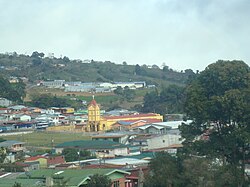
Santa Rosa is a district of the Oreamuno canton, in the Cartago province of Costa Rica.
Location
1 explorer visited this place
3.2 km
Oreamuno is a canton in the Cartago province of Costa Rica. The head city is in San Rafael district.

5.8 km
The Irazú Volcano is an active volcano in Costa Rica, situated in the Cordillera Central close to the city of Cartago.
The name might have come from either the combination of "ara" and "tzu" or a corruption of Iztarú, which was the name of an indigenous village on the flanks of the volcano. In Costa Rica it is known by the name of "El Coloso" due to the catastrophes that it has unleashed in the past.
The volcano's summit has several craters, one of which contains Diego de la Haya, a green crater lake of variable depth. At 11,260 feet, the Irazú Volcano is the highest active volcano in Costa Rica. It is thus a popular tourist spot. It is easily visited from San José, the Costa Rican capital, with a road leading right up to the summit craters and a weekly bus service to the top. The summit of the volcano also houses a few television transmitters for television stations in San José.
From the top it is possible to see both the Atlantic and Pacific oceans on a clear day. However, such clear days are rare, and the volcano's summit is usually cloud-covered.
The volcano is contained within the Irazú Volcano National Park, which spreads across 5,705 acres. The national park contains both primary and secondary montane forests and is home to armadillos, owls, rabbits, foxes, woodpeckers, and hummingbirds.

5.9 km
Irazú Volcano National Park, or in Spanish the Parque Nacional Volcán Irazú, is a National Park in the Central Conservation Area of Costa Rica that encompasses the area around the Irazú Volcano in Cartago Province which incorporates what used to be the Ruben Torres Rojas Forest Reserve now called the Prusia Forest Reserve. The volcano is still active although the last major eruptions were between 1963 and 1965, with occasional minor eruptions and some small lava flows since that time.
The park is the site of a reforestation project to restore the area which was destroyed by the eruptions. The forest is made up of conifers and other exotic and native species and also a native forest consisting mainly of oaks and alder, protecting the watershed of the Reventado River.
The Crater Principal lake has an unusual greenish yellow coloring caused by rainfall dissolving the minerals along the craters walls. It has also been known to change colour to rust-red depending on the minerals present. The inactive, dry Diego de la Haya crater is just to the East of the Crater Principal and is filled with volcanic ash.
6.0 km
The Cordillera Central is a volcanic mountain range in central Costa Rica which continues from the Continental Divide to east of Cordillera de Tilarán. It extends 80 km from Tapezco Pass to the Turrialba Volcano and ends on the Pacuare River. It is separated from Cordillera de Tilarán by Balsa River and Platanar and Zarcero hills. The Cordillera Central is part of the American Cordillera, an almost continuous sequence of mountain ranges that form the western "backbone" of North, Central, and South America, and Antarctica.
It contains four large volcanoes Poás, Barva, Irazú and Turrialba. The highest peak is Irazú at 3,432 m.
South of the range lie elevated plains of central tectonic depression of Costa Rican Central Valley.
Cordillera Central's four main volcanoes are protected as national parks. The volcanic massif of the Poás Volcano is the central feature of Poás Volcano National Park, featuring permanent fumarolic activity. Barva Volcano has prominent hydrothermal activity, and is a part of Braulio Carrillo National Park.
Irazú Volcano National Park contains Irazú Volcano, the highest volcano of Costa Rica. The height of the volcano makes it a strategic site for telecommunications; many national television and radio stations have antennas at the summit.
Turrialba Volcano National Park, centered on Turrialba Volcano, has fumarolic activity and gas emissions.
7.2 km
Cascajal is a district of the Vázquez de Coronado canton, in the San José province of Costa Rica.