

 English
 Français

Diocese of Bradford
The Diocese of Bradford is a former Church of England diocese within the Province of York. The diocese covered the area of the City of Bradford, Craven district, the former Sedbergh Rural District now in Cumbria and the parts of the Lancashire boroughs of Pendle and Ribble Valley that are within Yorkshire's historic boundaries. The seat of the episcopal see was Bradford Cathedral and the bishop was the diocesan Bishop of Bradford. The diocese was founded on 25 November 1919 from part of the Diocese of Ripon and dissolved in the creation of the Diocese of Leeds on 20 April 2014. The church of Saint Peter was elevated to cathedral status in 1919.
Nearby Places View Menu

59 m
Bradford Cathedral
Bradford Cathedral, or the Cathedral Church of St Peter, is an Anglican cathedral in Bradford, West Yorkshire, England, one of three co-equal cathedrals in the Diocese of Leeds alongside Ripon and Wakefield. Its site has been used for Christian worship since the 7th century, when missionaries based in Dewsbury evangelised the area. For many centuries it was the parish church of St Peter and achieved cathedral status in 1919. The cathedral is a Grade I listed building.

111 m
Sieges of Bradford
The sieges of Bradford (also known as the Battle of the Steeple), were two very short-lived sieges that took place separately in the town of Bradford, Yorkshire, in December 1642 and early July 1643, just after the Royalist victories in Pontefract (1642), and the Battle of Adwalton Moor (1643) respectively. In the second siege, with the Parliamentarian forces dispersed to the west in and around Halifax, the Earl of Newcastle subjected Bradford to a brief siege to enforce rule and allegiance to the king.
The first siege gave rise to the term "Bradford Quarter", apparently a misinterpretation by the defenders of Bradford who, on hearing a Royalist officer asking for quarter, assured him that they would "quarter him". The term "give them Bradford Quarter", was used by the Royalists against the defenders of the Bradford during the second siege. The second siege was noted for its apparent salvation from slaughter after the Earl of Newcastle was visited by a wraith-like figure imploring him to "pity poor Bradford...".
The sieges were also notable in that to protect the church and steeple, bales of wool were hung from the tower in an effort to deflect, or deaden the impact of cannon-fire from the Royalists. The siege was said to have decimated Bradford and afterwards, famine and pestilence followed in its wake which affected Bradford for a hundred years. Some even state that as Bradford was withered, it allowed Leeds to flourish as the powerhouse in the region.
181 m
Paper Hall
Paper Hall is a Grade II* listed building in Bradford, West Yorkshire, England, noted for being the oldest domestic building in the city centre and for housing the city's first spinning machines. Its then owner James Garnett is credited with bringing the industrial revolution to Bradford, which became one of the manufacturing centres of Britain in the 19th century.
243 m
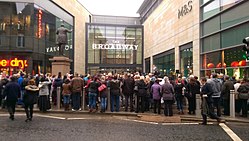
The Broadway, Bradford
The Broadway is a shopping and leisure complex in the centre of Bradford, West Yorkshire, England, which opened on 5 November 2015. It was built and was operated, in its first year, by the Westfield Corporation but is owned by New River. It is currently operated by Munroe K Asset Management Ltd.
Buildings were demolished and roads rerouted to make way for the development in 2004; but because of continued failure to secure buy-in from enough businesses, construction did not begin in earnest until January 2014: for most of the intervening years, the site had little apart from a deep excavation, though from 2010 the area round the edge of the site was laid out as an urban park.
The "hole in the ground" was very unpopular in Bradford, and at one point the site was occupied by protestors.