


Les jardins de Shalimar sont des jardins créés par le maharaja de Kapurthala dans sa ville sur le modèle des jardins de Shalimar à Lahore.
Book your tour near
Jardins de Shalimar
Book Now
4.3
in partnership with
GetYourGuide.com
Location
1 explorer visited this place

399 m
Kapurthala State was a kingdom and later princely state of the Punjab Province of British India. Ruled by Ahluwalia Sikh rulers, spread across 510 square miles. According to the 1901 census the state had a population of 314,341 and contained two towns and 167 villages. In 1930, Kapurthala became part of the Punjab States Agency and acceded to the Union of India in 1947.
In colonial India, Kapurthala State was known for its communal harmony, with its Sikh ruler Jagatjit Singh building the Moorish Mosque for his Muslim subjects. At the time of the Indian independence movement, the ruler of the Kapurthala State opposed the partition of India and advocated for a united, secular country.

700 m
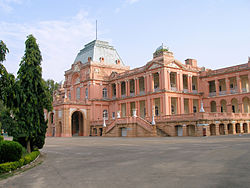
Kapurthala is a city in the Punjab state of India. It is the administrative headquarters of the Kapurthala District. It was the capital of the Kapurthala State, a princely state in British India. It is an immediate neighbour of Jalandhar city proper, and a part of the Jalandhar Metropolitan Region. The aesthetic mix of the city, with its prominent buildings based on French and Indo-Saracenic architecture self-narrate its princely past. And for this reason, it has often been referred to as the “Paris of Punjab”. It is also known as the 'City of Palaces & Gardens'. According to the 2011 census, Kapurthala is the least populated city in India.
840 m
Kapurthala District is a district of the state of Punjab in northern India. The city of Kapurthala is the district's headquarters.
Kapurthala District is one of the smallest districts of Punjab in terms of both area and population, with 815,168 people by the 2011 census. The district is divided into two noncontiguous parts—the main Kapurthala-Sultanpur Lodhi portion and the Phagwara tehsil.
The Kapurthala-Sultanpur Lodhi part lies between north latitude 31° 07' and 31° 22' and east longitude 75° 36'. In the north it is bound by Hoshiarpur, Gurdaspur, and Amritsar districts, in the west by the Beas River and Amritsar district, and in south by the Sutlej River, Jalandhar district, and Hoshiaripur district.
Phagwara tehsil lies between north latitude 31° 22' and east longitude 75° 40' and 75° 55'. Phagwara lies on the National Highway No 1, and the tehsil is much more industrially developed than the remainder of Kapurthala District. Phagwara is situated at a distance of 19 kilometres southeast of Jalandhar, and the tehsil is bounded on two sides by Jalandhar District whereas north by Hoshiarpur district and east by S B S Nagar District.
The district has three subdivisions/tehsils: Kapurthala, Phagwara, and Sultanpur Lodhi. The total area of the district is 1,633 km of which 909.09 km2 is in Kapurthala tehsil, 304.05 km2 is in Phagwara tehsil and 451.0 km2 is in Sultanpur Lodhi tehsil. The economy of the district is still predominantly agricultural.

1.1 km
Kapurthala is one of the 117 Legislative Assembly constituencies of Punjab state in India.
It is part of Kapurthala district. As of 2022, it is represented by Rana Gurjeet Singh of the Indian National Congress.
1.9 km
Sainik School Kapurthala is one of 33 Sainik Schools across India. The school was inaugurated in July 1961 by the then Defence Minister V.K. Krishna Menon, with the objective of preparing boys and girls for entry into National Defence Academy in Khadakwasla. Its motto is "Knowledge, Humility and Discipline". It is a fully residential school for boys only, providing public school education. It has produced more than 1150 officers for the Indian armed forces through National Defence Academy. It is the only school among the 33 Sainik Schools which has held the Defence Minister's trophy continuously for nine years. The school was the former palace of Maharaja Jagatjit Singh of Kapurthala.