


Angle Lifeboat Station (Welsh: Gorsaf Bad Achub Angle) is located near the village of Angle, on the southern side of the entrance to the Milford Haven Waterway, in Pembrokeshire, Wales. A lifeboat was first stationed at Angle by the Royal National Lifeboat Institution (RNLI) in 1868. The station currently operates a Tamar-class lifeboat, 16-11 Mark Mason (ON 1291), on station since 2009.
Gallery


Sponsored
Location
1 explorer visited this place

453 m
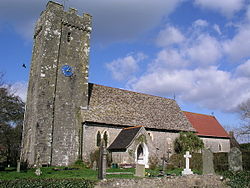
Sailors' Chapel, Seamen's Chapel or Fishermen's Chapel is a Grade I listed building in Angle, Pembrokeshire, Wales. The chapel, which is dedicated to St Anthony, is located in the churchyard of St Mary's parish church. It was founded in 1447 and was formerly used as a receiving place for the bodies of drowned sailors.
769 m
Angle is a village, parish and community on the southern side of the entrance to the Milford Haven Waterway in Pembrokeshire, Wales. The village school has closed, as has the village shop. There is a bus link to Pembroke railway station.
The Sailors' Chapel, a Grade I listed building, is in the church graveyard.
At Castle Farm, there is a Pele tower and above Castle Bay there are the remains of an Iron Age fort. On the headland there are visible remains of medieval strip farming.

1.3 km
The Angle Peninsula Coast on the southern side of the entrance to the Milford Haven Waterway in Pembrokeshire, Wales, is a Site of Special Scientific Interest. There is a wide range of wildlife and a former Royal Air Force station.
The peninsula is rich in Second World War defences and the site of the former air base RAF Angle. The hollows in the banks around it were used to house machine guns in the Second World War and there was a searchlight battery here. Inland from East Picket bay are the remnants of the E-Pens used to house fighter aircraft if they were needed. In a field close to the World War I memorial there are the remains of an anti-aircraft post. On a section of the coastal path just past the RNLI lifeboat house there are visible remains of an anti-aircraft post. This site was later changed and used to house a 40 mm Rolls-Royce cannon. At the north hill, there are remains of a Laing hut that was used as housing for a searchlight. On a rocky patch of ground at west pill is a brick mine watcher hut. This was used specifically to watch out for the enemy who may be laying mines in Milford Haven.
RAF Angle was an airfield during World War II. It opened in 1941 after Luftwaffe attacks against Pembroke Dock. The airfield, which began as a station for No. 10 Group, Fighter Command, housed several squadrons during the war such as No. 312 Squadron RAF and the Canadian 412 Transport Squadron. Planes included Supermarine Spitfires, Westland Whirlwinds and Hawker Hurricanes. In 1943 operational control passed on to the Fleet Air Arm of the Royal Navy. During this time a Sunderland flying boat landed at Angle airfield after receiving hull damage during a rescue. It returned to the RAF and became home to the Coastal command unit who tested weapons that could be used against German U-boats. After the war was over the buildings were no longer used and many were removed in the 1980s; however, some still stand in remote locations.
On 15 February 1996, the oil tanker Sea Empress grounded at the Milford Haven Waterway entrance, spilling 72,000 tonnes of crude oil.
The coastline around Angle was severely damaged. The effect of the oil spill lasted several years and cost £60 million.

1.3 km
Chapel Bay Fort is located on the southern shore of the Milford Haven Waterway, Pembrokeshire, Wales. The fort is approximately 1 mile from the village of Angle. One of a series of forts built as part of the inner line of defence of the Haven following the Royal Commission on the Defence of the United Kingdom, it is a Grade II Listed Building. and is also known as "Chapel Bay Battery".
Construction began in 1890 and was completed in 1891 at a cost of £11,779. The battery was the first fortification in the area to be built of mass concrete. It could accommodate 91 men and had mess room and sick bay facilities. Its initial armament was three ten inch rifled muzzle-loading guns.
From June 1900 until August 1901, the battery was reconstructed to take more modern armament - three 6-inch breech-loading guns. Throughout the First World War, the fort remained in military hands, but it was decommissioned in 1920. It was sold to the Angle Estate in 1932. The battery was used during the Second World War when a mining observation post was built on the site. In recent years the fort was acquired privately and now functions as a museum, following a £500,000 grant from the Welsh Assembly. One of the fort's original 10-inch guns has been re-mounted as part of the restoration. The site opened to the public in April 2015.

1.7 km
Royal Air Force Angle or more commonly RAF Angle is a former Royal Air Force station located on the Angle Peninsula Coast, 8 miles west of Pembroke, Pembrokeshire, Wales. It was operational from 1 June 1941 to 11 July 1946, having been used by both the Royal Air Force and the Royal Navy.
The village of Angle is 0.5 miles north of the airfield, which is located along the coast. Notable landmarks are, Freshwater West beach to the south of the airfield, and the St. Gowans lightship, 8 miles south of Linney Head.
The airfield opened as an RAF Fighter Command forward airfield, within No. 10 Group RAF as part of the Fairwood Common Sector. During the previous year the Luftwaffe had attacked Pembroke Docks and Milford Haven with the freedom from any consequences of air defences, causing a furore at high levels of state, and highlighting the need for anti-aircraft operations for the whole of the area.