

 English
 Français
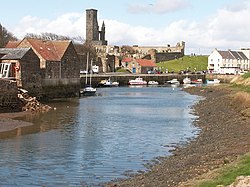
Kinness Burn
The Kinness Burn is a 5+3⁄4 miles (9.5 kilometres) long burn (stream) in Fife, Scotland. It flows into the North Sea through the inner harbour of St Andrews on the east coast of Fife. The name of the village of Strathkinness, located 3 miles west of St Andrews, means the valley (strath) of the Kinness. The source of the burn is on a low Clatto hill to the west of Strathkinness, near the village of Blebocraigs. The St Andrews Botanic Garden is located on the banks of the Kinness Burn. The Fife Pilgrim Way follows the Kinness Burn for about a mile within St Andrews, where it joins the Lade Braes Walk.
Nearby Places View Menu

104 m
Church of St Mary on the Rock
The Church of St Mary on the Rock, or St Mary's Collegiate Church, was a secular college of priests based on the seaward side of St Andrews Cathedral, St Andrews, just beyond the precinct walls. It is known by a variety of other names, such as St Mary of the Culdees, Kirkheugh and Church of St Mary of Kilrymont.
Although not founded as a collegiate church until the 1240s, Scotland's first, it represented a corporate continuation of the association of clergy known as the Culdees or Céli Dé, "vassals of God". The church lasted for several centuries, but did not long outlast the Scottish Reformation, and today little of the original structure has survived.
247 m
St Andrews Cathedral Priory
St Andrews Cathedral Priory was a priory of Augustinian canons in St Andrews, Fife, Scotland. It was one of the great religious houses in Scotland, and instrumental in the founding of the University of St Andrews.

247 m
St Andrews Sarcophagus
The Saint Andrews Sarcophagus is a Pictish monument dating from the second half of the 8th century. The sarcophagus was recovered beginning in 1833 during excavations by St Andrew's Cathedral in Scotland, and in 1922 the surviving components were reunited. The sarcophagus is on display at the Cathedral museum in St Andrews, close to the site of its discovery.

253 m
St Andrews Cathedral
The Cathedral of St Andrew (often referred to as St Andrews Cathedral) is a ruined cathedral in St Andrews, Fife, Scotland. It was built in 1158 and became the centre of the Medieval Catholic Church in Scotland as the seat of the Archdiocese of St Andrews and the Bishops and Archbishops of St Andrews. It fell into disuse and ruin after the Catholic mass was outlawed during the 16th-century Scottish Reformation. It is a monument in the custody of Historic Environment Scotland. The ruins indicate that the building was approximately 119 m (390 ft) long, and is the largest church to have been built in Scotland.