Location Image

River Gaunless

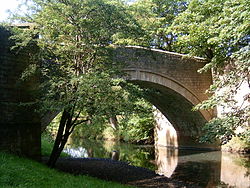
The Gaunless is a tributary river of the Wear in County Durham, England. Its name is Old Norse, meaning "useless". The Gaunless Viaduct, built in 1825, was the tallest viaduct on the South Durham & Lancashire Union Railway. Formed just south of the village of Copley, by the confluence of Arn Gill (to the south, coming west from south of Langleydale Common) and Hindon Beck (to the north and coming east from Langleydale Common), the Gaunless wends its way east, passing the settlements of Butterknowle, Cockfield and Evenwood and through West Auckland before skirting the south and east of Bishop Auckland on its way to meet the River Wear. An extension of the Copley Met.Office weather station has been placed at the head of the river at Copley Lead Mill to study its unique climate of frost and snow. It lies in a frost hollow and receives no sunshine between October and March because of its geography.

Nearby Places View Menu
Location Image
513 m

Auckland Castle

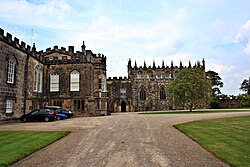
Auckland Castle, also known as Auckland Palace, is a former bishop's palace located in the town of Bishop Auckland in County Durham, England. The castle was a residence of the bishops of Durham from approximately 1183 and was their primary residence between 1832 and 2012, when the castle and its contents were sold to the Auckland Castle Trust (now the Auckland Project). It is now a tourist attraction, but still houses the bishop's offices. The castle is notable for its chapel, described as "one of the finest rooms in North East England" in the Buildings of England series, which was the medieval great hall until it was remodelled by Bishop John Cosin in 1661–1665. The woodwork, which includes the pulpit, stalls, and screen, was commissioned by Cosin and combines Gothic and Baroque forms. The castle also contains twelve paintings depicting Jacob and His Twelve Sons by the Spanish painter Francisco de Zurbarán; the thirteenth portrait, Benjamin, is a copy, as the original hangs in Grimsthorpe Castle, Lincolnshire. Auckland Castle is a grade I listed building.
Location Image
623 m

Bishop Auckland Town Hall

Bishop Auckland Town Hall is a municipal facility in the Market Place, Bishop Auckland, Co Durham, England. It is a Grade II* listed building.
Location Image
736 m

Vinovia

Vinovia or Vinovium was a Roman fort and settlement situated just over 1 mile (1.6 km) to the north of the town of Bishop Auckland on the banks of the River Wear in County Durham, England. The fort was the site of a hamlet until the late Middle Ages, but the modern-day village of Binchester is about 2 miles (3 km) to the east, near Spennymoor. The ruins are now known as the Binchester Roman Fort.
Location Image
983 m

Bishop Auckland

Bishop Auckland ( AWK-lənd) is a market town and civil parish at the confluence of the River Wear and the River Gaunless in County Durham, England. It is 12 miles (19 km) northwest of Darlington and 12 miles (19 km) southwest of Durham. Much of the town's early history surrounds the Bishops of Durham and the establishment of Auckland Castle's predecessor, a hunting lodge, which became the main residence of Durham Bishops. This is reflected in the first part of the town's name. During the Industrial Revolution, the town grew rapidly as coal mining became its largest industry. Decline in the coal mining industry during the late twentieth century has changed the town's largest sector to manufacturing. Since 1 April 2009, the town's local authority has been Durham County Council. The unitary authority replaced the previous Wear Valley District and Durham County councils. The parliamentary constituency of Bishop Auckland is named after the town. It is currently held by Sam Rushworth of the Labour Party. The town is twinned with the French town of Ivry-sur-Seine.