

 English
 Français

Carleton, Penrith
Carleton is a suburb of the town of Penrith, Cumbria, England, that has seen a huge growth in housing since the 1960s and is, of 2018, still expanding due to the Carleton Meadows, Carleton Manor and Woodberry Heights developments. It was formerly a separate small village or hamlet one mile east of the centre of Penrith.
Nearby Places View Menu

968 m
Brocavum
Brocavum is the Latin name of a Roman fort at Brougham near Penrith, Cumbria. The fort survives as earthworks, but no excavation of these has been carried out so far.

968 m
Brougham Castle
Brougham Castle (pronounced ) is a medieval building about 2 miles (3.2 km) south-east of Penrith, Cumbria, England. The castle was founded by Robert I de Vieuxpont in the early 13th century. The site, near the confluence of the rivers Eamont and Lowther, had been chosen by the Romans for a Roman fort called Brocavum. The castle, along with the fort, is a scheduled monument: "Brougham Roman fort and Brougham Castle".
In its earliest form, the castle consisted of a stone keep, with an enclosure protected by an earthen bank and a wooden palisade. When the castle was built, Robert de Vieuxpont was one of the only lords in the region who were loyal to King John. The Vieuxponts were a powerful land-owning family in North West England, who also owned the castles of Appleby and Brough. In 1264, Robert de Vieuxpont's grandson, also named Robert, was declared a traitor, and his property was confiscated by Henry III. Brougham Castle and the other estates were eventually returned to the Vieuxpont family, and stayed in their possession until 1269, when the estates passed to the Clifford family through marriage.
With the outbreak of the Wars of Scottish Independence, in 1296, Brougham became an important military base for Robert Clifford, 1st Baron de Clifford. He began refortifying the castle: the wooden outer defences were replaced with stronger, more impressive stone walls, and a large stone gatehouse was added. The importance of Brougham and Robert Clifford was such that, in 1300, he hosted King Edward I of England at the castle. Robert's son, Roger Clifford, was executed as a traitor, in 1322, and the family estates passed into the possession of King Edward II of England, although they were returned once his son Edward III became king. The region was often at risk from the Scots, and in 1388, the castle was captured and sacked.
Following this, the Cliffords began spending more time at their other castles, particularly Skipton Castle in North Yorkshire. Brougham descended through several generations of Cliffords, intermittently serving as a residence. However, by 1592, it was in a state of disrepair, as George Clifford, 3rd Earl of Cumberland was spending more time in southern England due to his role as Queen's Champion. The castle was briefly restored in the early 17th century, to such an extent, that King James I of England was entertained there in 1617. In 1643, Lady Anne Clifford inherited the estates, including the castles of Brougham, Appleby, and Brough, and set about restoring them. Brougham Castle was kept in good condition for a short time, after Lady Anne's death in 1676; however, Thomas Tufton, 6th Earl of Thanet, who had inherited the Clifford estates, sold the furnishings in 1714. The empty shell was left to decay, as it was too costly to maintain. As a ruin, Brougham Castle inspired a painting by J. M. W. Turner, and was mentioned at the start of William Wordsworth's poem The Prelude, as well as becoming the subject of Wordsworth's Song at the Feast of Brougham Castle upon the Restoration of Lord Clifford, the Shepherd, to the Estates and Honours of his Ancestors. The castle was left to the Ministry of Works, in the 1930s, and is today maintained by its successor, English Heritage.

1.0 km
Penrith A.F.C.
Penrith Association Football Club are a football club based in Penrith, Cumbria, England.
They play in the Northern League Division One and their home games take place at the Frenchfield Park Stadium.
The club moto is RES-NON-VERBA which is the Latin phrase that translated means "actions speak louder than words" or "deeds not words" and features on the club crest.
The team are also known as "The Bonny Blues" as the home strip features a blue shirt with blue shorts and blue socks; the away colours are a red shirt with red shorts and red socks.
1.2 km
Eamont Bridge (structure)
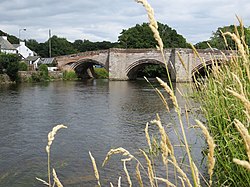
Eamont Bridge is a road bridge over the River Eamont, at the village of the same name, immediately to the south of Penrith, Cumbria, England. It is a scheduled monument and a Grade I listed building (it has two listings as it spans a parish boundary and is listed under both).
The narrow bridge lies on the A6 road, and until the opening of the M6 motorway, it was a notorious bottleneck. It is still controlled by traffic lights.
The bridge crosses the old county boundary between Cumberland and Westmorland and is one of the oldest bridges in the county still in daily use. It was built in 1425 after the Bishop of Durham, Thomas Langley, offered indulgences to anyone contributing towards its construction, and it was widened in 1875. It is a slightly humpbacked three-arched bridge made of grey sandstone with alterations in red sandstone. The solid parapets include pedestrian refuges above the pillars. Like the village, the bridge stands partly in Yanwath and Eamont Bridge parish and partly in Penrith.
In December 2015, the bridge was declared unsafe and closed to traffic, following severe flooding caused by Storm Frank. The bridge sustained significant damage, with a one-metre hole reported in a supporting pillar. It was repaired and reopened in March 2016.