


La chapelle de la clinique Sainte-Barbe est située dans l'enceinte de cette clinique, dans la rue Sainte-Marguerite (quartier de la Gare) à Strasbourg. Le bâtiment principal de la clinique Sainte-Barbe est construit par Joseph Massol en 1757. La chapelle actuelle est construite en 1877 par Eugène Petiti. À l'intérieur de la chapelle se trouve une Annonciation réalisée par Ignace Stern dit Stella et offerte par le roi de Bavière Louis Ier.
Gallery


Sponsored
Location
1 explorer visited this place
133 m
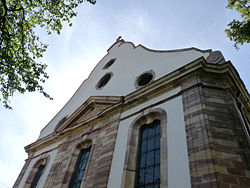
The Church of Saint Aurelia, situated in the west of Strasbourg near the railway station, is one of the Strasbourg churches with the longest history. A Lutheran church since the Reformation, the church is of particular historical and architectural interest.

191 m
The École nationale d'administration was a French grande école, created in 1945 by the then provisional chief of government Charles de Gaulle and principal co-author of the 1958 Constitution Michel Debré, to democratize access to the senior civil service. The school was frequently criticized from the 1970s onward for having built an incredibly elitist culture as well as being a stronghold for technocrats. As a result, it was dissolved on 31 December 2021 and replaced by the Institut national du service public.
The ENA selected and supervised the initial training of senior French officials. It was considered to be one of the most academically demanding French schools, both because of its low acceptance rates and because a large majority of its candidates had already graduated from other elite schools in the country such as Sciences Po or the École Polytechnique. Thus, within French society, the ENA stood as one of the main pathways to high positions in the public and private sectors. Indeed, 4 Presidents of France from the beginning of the 5th Republic in 1958 to the present day and many prime-ministers and ministers, studied at the ENA.
Originally located in Paris, it had been relocated to Strasbourg in order to emphasize its European character. It was based in the former Commanderie Saint-Jean, though continued to maintain a Paris campus. ENA produced around 80 to 90 graduates every year, known as étudiants-fonctionnaires, "enaos" or "énarques". In 2002 the Institut international d'administration publique which educated French diplomats under a common structure with the ENA was merged with it. The ENA shares several traditions with the College of Europe, which was established shortly after.
In 2019, President Emmanuel Macron announced he would propose to abolish and replace the ENA. Macron is an ENA graduate himself, but the tight network of ENA graduates influencing the French civil service has been decried by populist protests such as the yellow vests movement as an elite governing class out of touch with the lower social classes. In April 2021, Macron confirmed the closure of the school, calling the closure "the most important reform of the senior public service" since the school's creation in 1945.

247 m
The Musée d'Art Moderne et Contemporain de Strasbourg is an art museum in Strasbourg, France, which was founded in 1973 and opened in its own building in November 1998.
One of the largest of its kind in France, the museum houses extensive collections of paintings, sculpture, graphic arts, multimedia and design from the period between 1870 and today, as well as a wide range of pieces in its photographic library. It owns a total of 18,400 works. Numerous exhibitions are organized annually, showing either the works of a particular artist or a retrospective of an artistic genre. The art library of the municipal museums, the art book shop of the municipal museums and a multi-purpose auditorium for conferences, films and concerts are also found in the same building. The spacious roof terrace accommodates a museum cafe.

252 m
The Canal du Faux-Rempart, also known as the Fossé du Faux-Rempart, is a canal in the centre of Strasbourg, France. The canal connects at both ends to the River Ill, thus surrounding the Grande Île that lies at the historic centre of the city.
The canal was originally an arm of the River Ill. Initially the bank on the inner, or city, side of the arm was fortified. In the thirteenth century a further wall was built along the middle of the channel. This fortified wall became known as the Faux Rempart or false rampart. Between 1831 and 1832, the mayor Frédéric de Turckheim removed the Faux Rempart in order to "allow a spacious navigation channel and freight transport within the city." In 1840, the canal was opened to navigation.
In its 2-kilometre length, the canal is crossed by 13 bridges, and passes through a single lock. Navigation is officially restricted to passenger trip boats only, which operate frequent circular cruises round the Grande Île and through the historic Petite France district of the city.
320 m
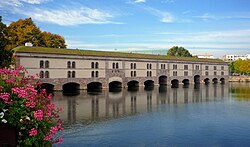
The Barrage Vauban, or Vauban Dam, is a bridge, weir and defensive work erected in the 17th century on the River Ill in Strasbourg, France. At that time, it was known as the Great Lock, although it does not function as a navigation lock in the modern sense of the word. Today it serves to display sculptures and has a viewing terrace on its roof, with views of the earlier Ponts Couverts bridges and Petite France quarter. It has been classified as a Monument historique since 1971.
The barrage was constructed from 1686 to 1690 in pink Vosges sandstone by the French engineer Jacques Tarade according to plans by Vauban. The principal defensive function of the barrage was to enable, in the event of an attack, the raising the level of the River Ill and thus the flooding of all the lands south of the city, making them impassable to the enemy. This defensive measure was deployed in 1870, when Strasbourg was besieged by Prussian forces during the Franco-Prussian War, and resulted in the complete flooding of the northern part of the suburb of Neudorf.
The barrage has 13 arches and is 120 metres in length. Within the structure an enclosed corridor links the two banks and a lapidarium serves to display ancient plaster casts and copies of statues and gargoyles from Strasbourg Cathedral and the Palais Rohan. Three of the arches are raised to permit navigation, and the corridor is carried across these by drawbridges. The roof was rebuilt in 1965–66 in order to construct the panoramic terrace. Admission to the barrage and terrace is free, and they are open daily from 09:00 to 19:30.
The Strasbourg Museum of Modern and Contemporary Art and the Commanderie Saint-Jean, now home to the prestigious École Nationale d'Administration, are both adjacent to the northern end of the barrage. The headquarters of the Bas-Rhin department is by the southern end.
Elle ornait le maître-autel de l'ancienne chapelle datant de 1842. C'est à cet endroit qu'au VIIe siècle, l'évêque saint Arbogast demanda d'être enterré, à l'époque sur le coteau Saint-Michel.
Book your tour near
Chapelle de la clinique Sainte-Barbe
Book Now
4.3
in partnership with
GetYourGuide.com
