


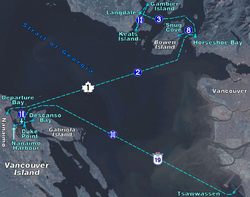
Queen Charlotte Channel forms the southern entrance to Howe Sound, British Columbia, Canada, between Bowen Island and West Vancouver. Queen Charlotte Channel is approximately 9 km long, and varies between 3 km and 5 km wide. The channel borders on to Strait of Georgia to the south (marked by the small Passage Island).
Book your tour near
Queen Charlotte Channel
Book Now
4.2
in partnership with
GetYourGuide.com
Location
1 explorer visited this place
864 m
The Bowen Island ferry travels between Snug Cove on Bowen Island, and Horseshoe Bay in the District of West Vancouver, British Columbia, Canada, a trip of three nautical miles across Queen Charlotte Channel. A scheduled ferry has been in operation since 1921, when Bowen Island was a popular holiday destination. Prior to that year, transportation to the island was by steamship from Vancouver, with only one trip daily. The Bowen Island ferry used a fleet of small passenger vessels until 1956, when a single car ferry began passenger service, and that ferry began carrying vehicles in 1958. In 2022 the route carried in excess of 1.2 million passengers plus 570 000 vehicles.
The Bowen Island ferry has no official or common name, and is only numbered as route 8, though this is likely only intended for internal documentation. It is currently run with the use of a single vessel, the Queen of Capilano.

1.3 km
Whytecliff Park is located in West Vancouver, British Columbia, Canada, near the Horseshoe Bay neighbourhood, which was originally named White Cliff City when it was first settled in 1909. The park is currently home to more than 200 marine animal species and is the first Marine Protected Area in Canada. Sea lions can be seen sunbathing on the beach during summer.

2.2 km
Horseshoe Bay, formerly known as Whytecliff and White Cliff City, is a community in West Vancouver, in the Canadian province of British Columbia. It is part of the Greater Vancouver area and marks the entrance to Howe Sound. It is also the western terminus of both Highway 1 on the BC mainland and the main route of the Trans-Canada Highway on the Canadian mainland. The Horseshoe Bay ferry terminal is one of BC Ferries' busiest terminals, serving an estimated 7 million passengers and 3 million vehicles every year.

2.2 km
Snug Cove is a community on the east coast of Bowen Island, British Columbia, opposite Horseshoe Bay. It is the site of the Bowen Island ferry terminal operated by BC Ferries, where most people and cargo travel between Bowen Island and the mainland. The island is 6 kilometres wide by 12 kilometres long and 3 kilometres west of the mainland, and has a population of around 3,700 people.
The Squamish hunters and fishermen were the first people to stay in the area using the site of the present community as a temporary camp. The Squamish name for this area was Xwilil Xhwm, which has been translated as "fast drumming ground" a name which has been connected to the Squamish story of how the black-tailed deer were created on the island. Early European settlers arriving in Snug Cove discovered shake dwellings and a smoke house.
Snug Cove is noted for its marina and its buildings from the early 1900s, some of which were built by the Union Steamship Company. In the 1920s some 5,000 people were known to arrive at Snug Cove and up to 800 couples could dance at what was then the largest dance hall in British Columbia. The resort was disbanded in the 1960s. Snug Cove is the location of The Bowen Island Public Library which is located in what is known as "The Old General Store".

2.5 km
Horseshoe Bay is a major ferry terminal of BC Ferries in British Columbia, Canada. Located in the community of Horseshoe Bay, a neighbourhood of West Vancouver, the terminal provides a vehicle ferry link from the Lower Mainland to Vancouver Island, the Sunshine Coast, and to Bowen Island, a small island in the southern part of Howe Sound.
Comprising three berths, Horseshoe Bay is the third largest BC Ferries terminal, after Tsawwassen and Swartz Bay.
And it borders on Howe Sound to the north (at the southernmost tip of Bowyer Island). The channel was named after the Royal Navy ship HMS Queen Charlotte, which was itself named after Queen Charlotte.