


Chojnice, en allemand : Konitz ou Conitz, est une ville de Pologne située au nord du pays, dans la voïvodie de Poméranie.
Gallery


Sponsored
Location
1 explorer visited this place
0 m
Gmina Chojnice is a rural gmina in Chojnice County, Pomeranian Voivodeship, in northern Poland. Its seat is the town of Chojnice, although the town is not part of the territory of the gmina.
The gmina covers an area of 458.34 square kilometres, and as of 2006 its total population is 16,014.
The gmina contains parts of the protected areas of Tuchola Landscape Park and Zaborski Landscape Park.

0 m
Chojnice County is a unit of territorial administration and local government in Pomeranian Voivodeship, northern Poland. It came into being on January 1, 1999, as a result of the Polish local government reforms in 1998. Its administrative seat and largest town is Chojnice, which lies 103 kilometres south-west of the regional capital Gdańsk. The county also contains the towns of Czersk, lying 30 km east of Chojnice, and Brusy, 24 km north-east of Chojnice.
The county covers an area of 1,364.25 square kilometres. As of 2019 its total population is 97,616, out of which the population of Chojnice is 39,890, that of Czersk is 9,910, that of Brusy is 5,188, and the rural population is 42,628.
Chojnice County on a map of the counties of Pomeranian Voivodeship
Chojnice County is bordered by Bytów County and Kościerzyna County to the north, Starogard County and Tuchola County to the east, Sępólno County to the south, and Człuchów County to the west.
0 m
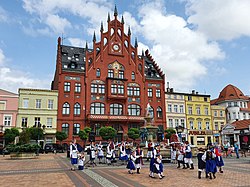
Chojnice is a town in northern Poland with a population of 38,789, near the Tuchola Forest. It is the capital of Chojnice County in the Pomeranian Voivodeship.
Founded in c. 1205, Chojnice is a former royal city of Poland and was an important center of cloth production. It is home to one of the oldest high schools in Poland, and played a significant role in Polish youth resistance against the Germanisation policies of Prussia following the Partitions of Poland. The town was also the site of several significant battles, and during World War II, German occupiers massacred approximately 2,000 Poles on its outskirts.
Chojnice is a railroad junction with connections to Brodnica, Kościerzyna, Piła, Szczecinek, and Tczew. It contains several Gothic and Baroque heritage sights, and is the largest town near the Tuchola Forest, a large forest complex in north-central Poland.
1.1 km
The Battle of Chojnice occurred during the 1939 German invasion of Poland on the first day of the hostilities, 1 September. A detached unit from the Polish army Chojnice Detached Group under Colonel Kazimierz Tadeusz Majewski, part of the Czersk Operational Group under Stanisław Grzmot-Skotnicki, was assigned the task of defending the city of Chojnice, a major regional communications center, against the advancing German 20th Motorized Infantry Division in order to protect the southern flank of Army Pomorze.
The German attacks started at 04:30 with Stuka dive bombers, from 3/1 Stuka Geschwader, attacking the Tczew bridge. The Wehrmacht then tried to sneak armoured cars into the station, but the Poles destroyed the bridge beforehand. Finally, an armored train attack on Chojnice was repulsed.
The Polish troops managed to hold back the German advance until the early afternoon, but at 14:00 the German troops threatened to surround the city and the Polish units were forced to retreat east towards Rytel. The 18th Pomeranian Uhlan Regiment was ordered to cover the retreat of the infantry, and launched a mounted attack against the Germans at Krojanty.
1.1 km
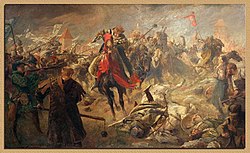
The Battle of Chojnice occurred on 18 September 1454 near the town of Chojnice, between Poland and the Teutonic Knights during the Thirteen Years' War. The battle was won by the Teutonic Knights.