


The Sheikh Dyrri Tekke (Albanian: Teqja e Sheh Dyrrit) or Shaykh Duri Tekke (Turkish: Şeyh Düri Tekkesi) is a tekke, located in Tirana, Albania. The tekke was designated as a Cultural Monument of Albania in 1963. The tekke relates to the Qadiriyya, a Sufi order.
Gallery


Sponsored
Location
173 m
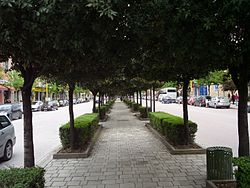
The Zogu I Boulevard or Boulevard Zog I was the first and the only boulevard at that time and is a major boulevard in Tirana, Albania, named after Zog I of Albania, the King of Albania who ruled the country between 1925 and 1939.
It runs in a northerly direction from the central Skanderbeg Square towards the recently completed New Boulevard of Tirana. South of the square the avenue becomes Dëshmorët e Kombit Boulevard, running south. During the communist period, the Boulevard was named 'Stalin Boulevard' and the name was changed after the restoration of democracy in Albania. For the first time the boulevard was named Boulevard Zogu I, and then it was called "Viale del Impero", then it was called "Boulevard Mussolini" and then it was divided into two parts, which were called "Boulevard Martyrs of the Nation" and "Stalin Boulevard".
This boulevard has been the 'Statue of Liberty' for all those who came to the capital by train, which was the most massive means of transport before the 90s. They came as visitors, as students, they came with work service, etc. It was the most favorite road in Tirana, as it was not only a road of various services, but thousands of romances were born from this road, boys and girls waiting for each other at the train, but also at the Faculty of Sciences. So, the Train street carries a lot of history and the municipality of Tirana has done one of the most beautiful things that has restored the glory of this boulevard, turning it into one of the most visited boulevards in Tirana.
It is 35 linear meters wide, increasing the width of the sidewalks on both sides to 8.25 meters. The boulevard has two vehicle lanes on both sides of it, and the material type for both the road and sidewalks is white stone asphalt.
On both sides of the boulevard, 4 new squares were built by the Municipality. The first square is the "pocket" square and is paved with stone tiles furnished with greenery. There is also the "village" square, which has a water fountain, which creates the impact of a village center. "Fortuzi" square was built on "Fortuzi" street, and the fourth square is "Universitetit" square, which already has a fantastic image.
In 2012, a statue of Zog I was placed in the boulevard in the event of the 100th Anniversary of the Independence of Albania.
295 m
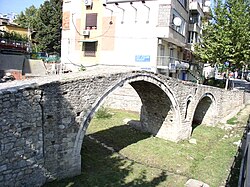
The Tanners' Bridge is an 18th-century Ottoman period stone footbridge located in Tirana, Albania. The bridge, built near the Tanners' Mosque, was once part of the Saint George Road that linked Tirana with the eastern highlands. The road was the route by which livestock and produce entered the city. The bridge crossed the Lanë stream near the area where butcher shops and leather workers were located. The bridge fell into disrepair when the Lanë was diverted in the 1930s. In the 1990s, the bridge was restored for use by pedestrians.

295 m
Tifozat Kuq e Zi, also known as the Albania National Football Team Supporters Club, is a non-profit football supporters' association for the Albania national football team and various national team sportive activities.
351 m
Dibër Street is a major street in Tirana, Albania. It runs northeast from the central Skanderbeg Square, just south of the Tirana International Hotel. The Mother Teresa Hospital is located on this street.

413 m
The Palace of Culture of Tirana houses the National Library of Albania as well as the National Theatre of Opera and Ballet. Situated in Skanderbeg Square, it was originally built on the Pazari i Vjetër area of Tirana at the behest of Enver Hoxha. The palace has changed little since its original construction in the 1960s.
The first stone of the new building was symbolically placed by Nikita Khrushchev in 1959. Construction was completed in 1963. The architecture is very similar to many communist-era social buildings in Eastern Europe.
Both the old bazaar and the historic mosque of Mahmud Muhsin Bey Stërmasi were destroyed under the plan, in adherence to Communist Albania's strict state atheism. The Ottoman mosque had been built from 1837 to 1840 and had a tiled roof as well as a striking minaret with a sherefe.
See also
Islam in Albania List of Religious Cultural Monuments of Albania