

 English
 Français
Colne Bridge Mill
Colne Bridge Mill (English: ) was a factory, built in 1775, in the village of Colne Bridge near Bradley and Kirkheaton, Huddersfield, West Yorkshire, England, which was destroyed by fire on 14 February 1818. It was owned by the wealthy manufacturer Thomas Atkinson (1779–1838), who was also proprietor of another business at Bradley Mills, Huddersfield.
Nearby Places View Menu

154 m
Colne Bridge
Colne Bridge (English: ) is an historic 18th-century bridge near Huddersfield, West Yorkshire, England. A Grade II listed stone-built arch bridge, it spans the River Colne between Bradley and Kirkheaton. A Colne Bridge was mentioned in the Fountains Abbey records of the 12th century. It gave its name to a village, and also to Colne Bridge Mill which was destroyed by fire in 1818.
According to Ted Ruddock, Colne Bridge may have been the design inspiration for John Smeaton's work on the Blackfriars Bridge.
213 m
River Colne, West Yorkshire
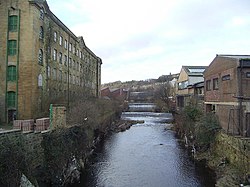
The River Colne in West Yorkshire is formed at the confluence of two brooks that originate in the Pennines close to Marsden. It flows in an easterly direction through the Colne Valley and Huddersfield towards Cooper Bridge where it flows into the River Calder.

582 m
Bradley railway station
Bradley railway station served the district of Bradley, West Yorkshire, England until closure in 1950.

595 m
Huddersfield Broad Canal
The Huddersfield Broad Canal or Sir John Ramsden's Canal, is a wide-locked navigable canal in West Yorkshire in northern England. The waterway is 3.75 miles (6 km) long and has 9 wide locks. It follows the valley of the River Colne and connects the Calder and Hebble Navigation at Cooper Bridge junction with the Huddersfield Narrow Canal near Aspley Basin in Huddersfield.
Construction was authorised in 1774, and the canal opened two years later. It became part of a trans-Pennine route in 1811 when the Huddersfield Narrow Canal joined it at Aspley Basin. Traffic was hampered by the long narrowboats used on the narrow canal that could not use Ramsden's Canal's shorter locks. Goods were transhipped at Aspley Basin, and although shorter narrowboats were built, its success as a trans-Pennine route was overshadowed by the Rochdale Canal which had wide locks throughout and joined the Calder and Hebble Navigation at Sowerby Bridge. The canal passed into railway ownership in 1845, but prospered into the 20th century. Railway ownership ceased in 1945, when it was bought by the Calder and Hebble Navigation, at which point the narrow canal across the Pennines was abandoned. The broad canal carried commercial traffic, particularly coal for power stations, until 1953.
After the formation of British Waterways in 1962, the canal was designated a cruiseway in 1968, which meant that it was mainly for leisure traffic. Use of the canal has increased significantly since the Huddersfield Narrow Canal re-opened in 2001, as it is no longer a dead end. Many of its structures have been given listed building status, in recognition of their historic importance.