


Szolnok (prononciation [solnok]) anciennement en français Zolnock est une ville hongroise, chef-lieu du comitat du Jász-Nagykun-Szolnok dans le centre du pays sur la Tisza.
Gallery


Sponsored
Location
1 explorer visited this place

411 m
Szolnok railway station is a railway station of the Hungarian State Railways in Szolnok, Hungary. Szolnok is a major railway junction, with lines branching out in all four cardinal directions.

1.0 km
Jász-Nagykun-Szolnok was an administrative county in the Kingdom of Hungary. Its territory, which is now in central Hungary, was slightly smaller than that of present Jász-Nagykun-Szolnok county. The capital of the county was Szolnok.
1.1 km
Szolnok County) was a county in the Kingdom of Hungary between the 11th century and 1426. It was made up of two disconnected parts, one in what later became Transylvania and the Partium, the other around the Tisza centred on the settlement of Szolnok. The county was eventually split and became:
Belső-Szolnok in what became the Principality of Transylvania, which was merged into Szolnok-Doboka County in 1876.
Közép-Szolnok in what became the Partium, which was merged into Szilágy County in 1876.
Külső-Szolnok in central Hungary, which de facto merged with Heves County in 1569 due to the Ottoman occupation of Külső-Szolnok. Heves was also occupied in 1596, with both becoming part of Eğri Eyalet until their reconquest by the Habsburgs in 1687. The two counties merged de jure in 1765 to become Heves and Külső-Szolnok County.
A second iteration of Szolnok County, centred on the city of Szolnok and corresponding to the former Külső-Szolnok, was created in 1850 following the Revolutions of 1848 in the Austrian Empire. It was created out of the south-eastern part of Heves and Külső-Szolnok County, separated from the other half – Heves County – mostly by the Tisza. As of 1854 Szolnok comprised the Stuhlbezirke of Tisza-Füred, Mező-Túr and Szolnok. It was part of the Pest-Ofen district, one of five districts of Hungary during this period. The 1850s changes to the counties were reversed in 1860, rendering this second Szolnok County defunct. Szolnok would again be separated from Heves in 1876, when it became part of Jász-Nagykun-Szolnok County, which also included the former Jászság and Nagykunság; Tisza-Füred however remained with Heves County until after World War II and the formation of the modern Jász-Nagykun-Szolnok County.

1.1 km
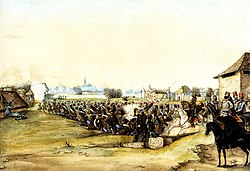
The First Battle of Szolnok was a battle in the Hungarian war of Independence of 1848-1849, fought on 22 January 1849 between the revolutionary Hungarian army led by General Mór Perczel against the cavalry brigade of the Austrian Empire led by General Ferenc Ottinger. The isolated troops of Ottinger were attacked by Perczel's superior army and were forced to retreat from Szolnok to Abony, then to Cegléd. This Hungarian victory was a sign that the Austrian troops, which after the occupation of the Hungarian capitals of Pest and Buda, believed that they already won the war, were far away from reaching that goal, and that the Hungarian army could cause them unpleasant surprises. After the Battle Perczel's troops continued the pursuit of Ottinger's troops to Cegléd.
1.1 km
The Second Battle of Szolnok took place during the Hungarian war of Independence of 1848–1849 on 5 March 1849. It was fought between the two divisions of the revolutionary Hungarian army led by Major-General János Damjanich and Major-General Károly Vécsey against the brigades of the Austrian Empire led by Major General Leopold Edler von Karger and General Ferenc Ottinger. The Hungarians won the battle and drove out the Austrian troops from the city, causing them heavy losses. This victory gave a moral boost to the Hungarians and shook the overconfidence of the Austrian main commander Field Marshal Alfred I, Prince of Windisch-Grätz who reported after the Battle of Kápolna from 26 to 27 February, that he scattered them and destroyed the rebellious hordes, and that he will capture the nest of the rebellion, Debrecen in a few days.