

 English
 Français

Newchurch in Pendle
Newchurch in Pendle is a village in the civil parish of Goldshaw Booth, Pendle, Lancashire, England, adjacent to Barley, to the south of Pendle Hill. It was formerly part of Roughlee Booth until its transferral in 1935.
Nearby Places View Menu

59 m
Goldshaw Booth
Goldshaw Booth is a civil parish in the Pendle district of Lancashire, England. It has a population of 248, and contains the village of Newchurch in Pendle and the hamlets of Spen Brook (53.846°N 2.267°W / 53.846; -2.267 (Spen Brook)) and Sabden Fold (53.841°N 2.290°W / 53.841; -2.290 (Sabden Fold)). Pendle Hill lies to the north.
The parish adjoins the Pendle parishes of Barley-with-Wheatley Booth, Roughlee Booth, Old Laund Booth and Higham-with-West Close Booth and the Ribble Valley parish of Sabden. It is part of the Forest of Bowland Area of Outstanding Natural Beauty (AONB).
According to the United Kingdom Census 2011, the parish has a population of 248, a decrease from 265 in the 2001 census.
Goldshaw Booth was once a township in the ancient parish of Whalley. This became a civil parish in 1866, forming part of the Burnley Rural District from 1894. The township extended to cover parts of the adjoining villages of Fence and Wheatley Lane, but this part transferred to Old Laund Booth in 1898. Parts of the parish also transferred to Sabden on its creation in 1904, and Newchurch in Pendle also used to straddle the boundary with Roughlee Booth but was brought entirely within the parish in 1935.
Along with Higham-with-West Close Booth, Barley-with-Wheatley Booth and Roughlee Booth, the parish forms the Higham with Pendleside ward of Pendle Borough Council.

104 m
St Mary's Church, Newchurch in Pendle
St Mary's Church is in the village of Newchurch in Pendle, Lancashire, England. The church is recorded in the National Heritage List for England as a designated Grade II* listed building. It is active Anglican parish church in the diocese of Blackburn, the archdeaconry of Blackburn and the deanery of Pendle. Its benefice is combined with that of St Thomas', Barrowford.
882 m
Ogden Reservoirs
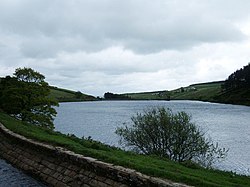
Upper and Lower Ogden Reservoirs are half a mile to the west of the village of Barley, in the Borough of Pendle, Lancashire, England. Constructed in the early 20th century, they supply drinking water to the town of Nelson. Today they are operated by United Utilities.

1.8 km
Wheatley Lane, Lancashire
Wheatley Lane is a village in Pendle, Lancashire, England. It is close to Nelson, Barrowford and Burnley. It lies to the north of the A6068 road, known locally as the Padiham bypass, or "The New Road".
Wheatley Lane is an extended village consisting of a ribbon development along 'Wheatley Lane Road' and abuts the sister village of Fence. The present village has now effectively absorbed the original hamlets of Wheatley Lane and Higher & Lower Harpers.
Historically, it lies in Old Laund Booth, in the Hundred of Blackburn. Up until Late Mediaeval times it lay in the Forest of Pendle, the hunting preserve of the King.
The older properties on the village consist largely of small stone-built cottages, with some later Victorian terraces and some 1950s council properties. Since the 1960s the remaining open fields on either side of the road have been developed for housing. There is unbroken countryside with walking country to the North to Pendle Hill and surrounding areas.
There is a Methodist Chapel and attached primary school in the village, and to the east, on the edge of the village, one of the few remaining Inghamite Chapels, which has an extensive graveyard. It is the burial place of Thomas Whitham who won the Victoria Cross in 1917.
Local tradition has it that the Harpers Inn, a local hostelry, was also originally built as a Methodist Chapel, but when the money ran out, it was sold and completed as a pub. The original name was the 'Who'd have thought it'.
Sports are catered for by Pendle Forest Sports Club Archived 9 July 2009 at the Wayback Machine.
Wheatley Lane has links with the Pendle Witches. In 1633, Edmund Robinson of Wheatley Lane reported that he had been taken by a witch to a barn at Hoarstones where he had seen 40 witches engaged in various devilish activities. He subsequently identified 19 witches and they were sent to trial in 1634, including Jenet Davies, a witness at the 1612 trial, and the daughter-in-law of Alice Nutter (one of the previous Pendle Witches). However, the judge deferred sentence and sent seven of them to London for further examination; only three survived the ordeal. After an enquiry all 19 were acquitted and Robinson later admitted that the story was a fabrication.