

 English
 Français
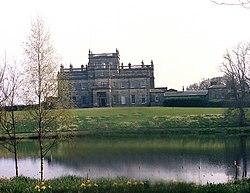
Kinmount House
Kinmount House is a 19th-century country house in the parish of Cummertrees in the historic county of Dumfriesshire in Dumfries and Galloway region, Scotland. It is located 3+1⁄2 miles (5.6 km) west of Annan. The house was designed by Sir Robert Smirke for the 6th Marquess of Queensberry and completed in 1820. It is protected as a category A listed building, and the grounds are included on the Inventory of Gardens and Designed Landscapes in Scotland.
Nearby Places View Menu

2.1 km
Cummertrees railway station
Cummertrees railway station was a railway station in Dumfries and Galloway south of Dumfries, serving the village of Cummertrees. The village lies some 3 miles (4.8 km) west of Annan and 12 miles (19 km) south of Lockerbie.

2.2 km
Cummertrees
Cummertrees is a coastal village and civil parish of Annandale in the historical county of Dumfriesshire in Dumfries and Galloway. It lies about 1 mile (1.6 km) inland, on the Pow Water to the northwest of Powfoot, 12 miles (19 km) from Dumfries and 3 miles (5 km) from Annan.

3.3 km
Powfoot Halt railway station
Powfoot Halt railway station was a railway station in Powfoot, near Dumfries and Galloway, Scotland, south of Cummertrees serving the workers at the MOD Powfoot Nitro-cellulose factory within the Parish of Cummertrees.

4.0 km
Ruthwell Cross
The Ruthwell Cross is a stone Anglo-Saxon cross probably dating from the 8th century, when the village of Ruthwell, now in Scotland, was part of the Anglo-Saxon Kingdom of Northumbria.
It is the most famous and elaborate Anglo-Saxon monumental sculpture, and possibly contains the oldest surviving text, predating any manuscripts containing Old English poetry. It has been described by Nikolaus Pevsner thus: "The crosses of Bewcastle and Ruthwell ... are the greatest achievement of their date in the whole of Europe."
The cross was smashed by Presbyterian iconoclasts in 1642, and the pieces left in the churchyard until they were restored and re-erected in the manse garden in 1823 by Henry Duncan. In 1887 it was moved into its current location inside Ruthwell church, Dumfriesshire, Scotland, when the apse which holds it was specially built. It was designated a scheduled monument in 1921, but had this removed in 2018, due to it being in a controlled, safe environment and not needing protection.