

 English
 Français

Plumpton Rocks
Plumpton Rocks is a man-made lake and surrounding pleasure gardens 3.5 miles (5.6 km) south-east of Harrogate in North Yorkshire, England, near the village of Plompton. The site is now operated as a tourist attraction by the owner, Robert de Plumpton Hunter. It is a Grade II* listed park and garden. The site is now generally spelt with a 'u' (the older name of the parish), although artist J. M. W. Turner referred to it as Plompton Rocks, in keeping with the modern spelling of the parish itself. The gardens reopened in July 2016 following a major restoration of the lake, dam and woods. It closed again in October 2019 to bring the lake dam up to standard for the Reservoirs Act 1975, and reopened in September 2022.
Nearby Places View Menu

440 m
Plompton Hall
Plompton Hall is a historic building in Plompton, a village in North Yorkshire, in England.
The Plompton estate was purchased by Daniel Lascelles in about 1755. He commissioned John Carr to rebuild the country house, with work starting in about 1757. However, Lascelles later bought Goldsborough Hall and decided to live there. In 1762, he had the unfinished house at Plompton demolished. The stable block, perhaps modelled on the one at Houghton Hall, was retained, with part of it converted to form a smaller house, now known as Plompton Hall. Both the house and the remaining part of the stables were altered in the 20th century, and in about 1980 the southern part of the stables was converted into a further house. Plompton Hall and its stables are separately grade II* listed.
The house has rusticated quoins, an eaves cornice, and a hipped stone slate roof. It has two storeys and three bays, the middle bay projecting under a pediment. In the centre is a full-height recessed round arch with voussoirs and an impost band. This contains a doorway with sidelights, above which is a window with a semicircular wrought iron balcony. Flanking the doorway are round-headed niches and semicircular niches above. The outer bays contain windows, blind in the ground floor and sashes above. At the rear is a canted bay window. Short flanking walls, about 3 metres (9.8 ft) high, link the house with the stables, the left wall with three ball and cushion finials.
The stable block is built of stone with a stone slate roof, and consists of three two-storey ranges around a courtyard. The main range is the west range, which has rusticated quoins, and seven bays. The middle bay projects slightly, and contains a tall archway with a rusticated surround, an open triangular pediment, and an octagonal cupola with clock faces, dentilled eaves and a ball finial with a moulded base. The flanking bays have impost bands, a moulded eaves cornice, and a hipped roof, and contain engaged arcading with windows. The east range has five lower bays, with taller bays at each end. The north range is a three-bay hay barn. In the courtyard, there is a dog kennel in the northwest corner, and a carriage house in the northeast corner.

781 m
Plompton
Plompton (formerly also spelt Plumpton) is a hamlet and civil parish south of Harrogate in North Yorkshire, England. It is close to the A661.
Plompton Hall is a Grade II* listed building designed by the architect John Carr and built about 1760. The composer John Hebden originates from the parish.

1.6 km
St Joseph and St James' Church, Follifoot
St Joseph and St James' Church is an Anglican church in Follifoot, a village in North Yorkshire, in England.
The church was commissioned by Joseph Radcliffe and the Reverend James Tripp, originally as a chapel of ease to All Saints' Church, Spofforth. It was opened on 22 October 1848, by the Bishop of Ripon. Its construction cost £750 and it could accommodate up to 150 worshippers. The pulpit dates from 1955 and was designed by Robert Thompson, while the pews, altar rail, table and Bishop's chair were replaced between 1964 and 1966. The tower was restored and reduced in height in 1975, and the whole church was restored in 1991. The building was grade II listed in 1985.
The church is built of gritstone with sandstone dressings and a slate roof. It consists of a nave, a south porch, and a chancel with a small north vestry. On the west gable is a gabled bellcote with one round-headed arch. The porch is gabled and contains an entrance with a pointed arch and a hood mould, and the windows are lancets. The windows in the chancel have stained glass inserted between 1879 and 1881 and are dedicated to the memory of Radcliffe.
1.8 km
Follifoot
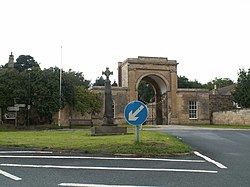
Follifoot is a village and civil parish in the county of North Yorkshire, England. It is situated on the A658 road and 4 miles (6.4 km) south-east from the town centre of Harrogate.