


LHôtel des Monnaies, est un bâtiment à Avignon, dans le département de Vaucluse.
Gallery


Sponsored
Location

83 m
The Festival d'Avignon, or Avignon Festival, is an annual arts festival held in the French city of Avignon every summer in July in the courtyard of the Palais des Papes as well as in other locations of the city. Founded in 1947 by Jean Vilar, it is the oldest existent festival in France. Alongside the official festival, the "In" one, a number of shows are presented in Avignon at the same time of the year and are known as the "Off".
In 2008, some 950 shows were performed during three weeks.

94 m
The Palais des Papes in Avignon, Southern France, is one of the largest and most important medieval Gothic buildings in Europe. Once a fortress and palace, the papal residence was a seat of Western Christianity during the 14th century. Six papal conclaves were held in the Palais, leading to the elections of Benedict XII in 1334, Clement VI in 1342, Innocent VI in 1352, Urban V in 1362, Gregory XI in 1370 and Benedict XIII in 1394. In 1995, the Palais des Papes was classified as a UNESCO World Heritage Site for its outstanding architecture and historical importance for the papacy.
128 m
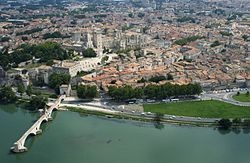
Avignon or Avignoun, IPA: [aviˈɲun]; Latin: Avenio) is the prefecture of the Vaucluse department in the Provence-Alpes-Côte d'Azur region of southern France. Located on the left bank of the river Rhône, the commune has a population of 92,188, with about 16,000 living in the ancient town centre enclosed by its medieval walls. The Communauté d'agglomération du Grand Avignon, a cooperation structure of 16 communes, had 197,102 inhabitants in 2022.
Avignon is France's 35th-largest metropolitan area according to INSEE with 337,039 inhabitants, and France's 13th-largest urban unit with 459,533 inhabitants. Its urban area was the fastest-growing in France from 1999 until 2010 with an increase of 76% of its population and an area increase of 136%.
Between 1309 and 1377, during the Avignon Papacy, seven successive popes resided in Avignon and in 1348 Pope Clement VI bought the town from Joanna I of Naples. Papal control persisted until 1791 when during the French Revolution it became part of France. The city is now the capital of the Vaucluse department and one of the few French cities to have preserved its city walls. This is why Avignon is also known as 'La Cité des Papes'.
The historic centre, which includes the Palais des Papes, Avignon Cathedral and the Pont d'Avignon, became a UNESCO World Heritage Site in 1995 because of its architecture and importance during the 14th and 15th centuries. The medieval monuments and the annual Festival d'Avignon – one of the world's largest festivals for performing arts – have helped to make the town a major centre for tourism.
128 m
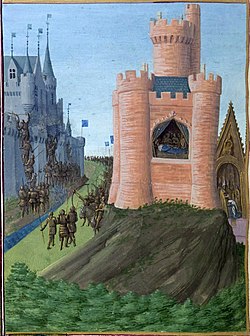
The siege of Avignon was the principal military action of the Albigensian Crusade of 1226. King Louis VIII of France besieged the town of Avignon, which lay within the Holy Roman Empire, from 10 June until 9 September, when it surrendered on terms.

135 m
Avignon Cathedral is a Roman Catholic church located next to the Palais des Papes in Avignon, France. The cathedral is the seat of the Archbishop of Avignon.
The cathedral is a Romanesque building, constructed primarily in the second half of the 12th century. The bell tower collapsed in 1405 and was rebuilt in 1425. In 1670–1672 the apse was rebuilt and extended. The extension led to the destruction of the medieval cloister.
The building was abandoned and allowed to deteriorate during the Revolution, but it was reconsecrated in 1822 and restored by the archbishop Célestin Dupont in 1835–1842. The most prominent feature of the cathedral is a gilded statue of the Virgin Mary atop the bell tower which was erected in 1859. The interior contains many works of art. The most famous of these is the mausoleum of Pope John XXII, a 14th-century Gothic edifice. It was moved in 1759, damaged during the Revolution, and restored to its original position in 1840. The cathedral was listed as a Monument historique in 1840. In 1995, the cathedral, along with the Palais des Papes and other historic buildings in the Avignon city center, became a UNESCO World Heritage Site because of its outstanding architecture and its importance during the 14th and 15th centuries.
