


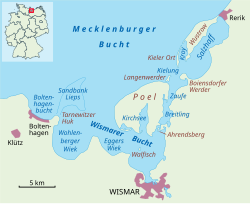
Walfisch est une île allemande inhabitée de la baie du Mecklembourg dans la mer Baltique située entre la ville de Wismar (à 4,5 km au nord) et l’île de Poel. Walfisch est une île très plate de 20 ha de superficie et d'une circonférence maximale de 500 × 300 m. C'est par ailleurs une réserve naturelle.
Gallery


Sponsored
Location

17 m
Walfisch is an uninhabited German island, in the Bay of Mecklenburg in the Baltic Sea. It lies approximately 4.5 kilometres north of the city of Wismar, south of the island of Poel. The island is very flat and has a maximum circumference of about 500 by 300 metres, a surface area of 20 hectares and is a nature reserve.
1.4 km
The Bay of Wismar or more commonly Wismar Bay or Wismarbucht is a well sheltered multi-sectioned bay in the southwestern Baltic Sea, in Mecklenburg-Vorpommern, Germany, and is considered the south-central part of the much larger arm of the Baltic known as the Mecklenburg Bay—a long fingerlike gulf oriented to the west-southwest from the Baltic proper. Wismar bay is considered one of the finest natural harbors on the Baltic, and served as the destination for much seaborne shipping until circa the 1910s when its minimum depths of 5 meters became too shallow for larger more modern ships. Today, because of the shallow sheltered waters the bay is the subject of much research via underwater archeology.
There are four lobe like parts of the Bay of Wismar which are themselves bays on its southern shores, each separated by a north intruding headland from the others and a broad channel running northwest to southeast parallel to the line formed by the tips of the four bounding headlands. The tips of the four headlands are remarkably well aligned and very closely co-linear spanning 10.80 mi northwest to southeast tip to tip along the channel along which the inlets are respectively Boltenhagen Bay, Wohlenberger Wiek, Eggers Wiek, and the inner bay. A channel, the Breitling between Poel island and the mainland is accounted part of the bay as well, which in its northern limit is the north shore of the island.
From the western headland to the eastern shore of the inner bay is 13.4 miles. All of the waters are bounded by Poel Island on one side—a large mainly agricultural and recreational island sheltering the most easterly parts of bay along most of its northern edge.
The sheltered anchorage extends over a rhombus shaped area in the southerly lee of Poel island roughly 3 miles N–S in the inner anchorage narrowing to 1.75 miles N-S between the innermost headland and southernmost tip of the island and roughly 5–6 miles that distance WNW to ESE.
In general, the main waters of the bay are located to the west, southwest and south relative to Poel Island which is wholly within Wismar Bay. The northern tip of the island in a line westerly to the headland of Großklützhöved north of the village of Klütz) forms the mouth of the bay.
Main ports: Wismar, 20 mi by rail north of Schwerin.


3.9 km
Ahrendsberg is an uninhabited island, 8.6 hectares in area, near the island of Poel in the Breitling, a strait off the Bay of Wismar on the Baltic coast of Germany.
The island, which is roughly 600 metres long and up to 220 metres wide, is dominated by salt meadows with shores that are dissected by creeks. The higher areas are generally very dry, nutrient-poor, and are characterised by stunted vegetation, for example dry, lean grassland with thistle and sand thyme. At the southern tip of the island is a short section of cliff.

3.9 km
Reric or Rerik was one of the Viking Age multi-ethnic Slavic-Scandinavian emporia on the southern coast of the Baltic Sea, located near Wismar in the present-day German state of Mecklenburg-Vorpommern Reric was established probably in 735 shortly after Slavs of the Obodrite tribe had started to settle the region. At the turn of the 9th century, the citizens of Reric allied with Charlemagne, who used the port as part of a strategic trade route that would avoid areas of Saxon and Danish control. It was destroyed in 808 AD by the Viking king Gudfred. The destroyed place was rebuilt by the Obodrites and continued to operate for a short until Drasco was murdered in Reric in 810 at the instigation of Gudfred. After that, the tradespeople were reportedly moved by the king to the Viking emporium of Hedeby near modern Schleswig.