Location Image

Department of Archaeology, University of Sheffield

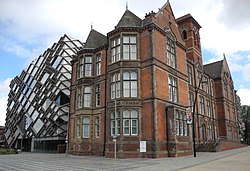
The Department of Archaeology at the University of Sheffield, UK, was an academic department dedicated to archaeology from 1976 to January 2025. As of 2025 it is no longer providing undergraduate and postgraduate courses in archaeology and its sub-disciplines based in the city of Sheffield, South Yorkshire or conducting archaeological associated research. It was founded in 1976, stemming from early archaeology programs in the 1960s as one of the first universities in the UK with a dedicated Department of Archaeology. The department's past research specialisms included Prehistoric Europe, Classical Antiquity, Medieval Archaeology and Post-Medieval Britain, as well as landscape archaeology, funerary archaeology, material culture studies, zooarchaeology, osteology, bioarchaeology, and the archaeology of the Mediterranean. From its inception in the 1960s, Sheffield developed a worldwide reputation for leading the science-based revolution in archaeology and theoretical turns in archaeological interpretation. As of May 2021, the department is under threat of closure or merging into other departments. The department would close at the end of the 2023/24 academic year. The University's Executive Board followed up on this decission in January 2025.

Nearby Places View Menu
Location Image
114 m

Glossop Road Baths

Glossop Road Baths is a building in Sheffield, South Yorkshire, England, which originally housed a swimming pool and Victorian Turkish baths. The first public baths in the city were opened on the site in 1836, following the cholera epidemic of 1832. The complex was rebuilt from 1877 to 1879 to a design by E. M. Gibbs, including an indoor swimming pool was opened, a Turkish bath suite and a hairdresser. In 1898, the complex was bought by the city council and a ladies' bath was added. The façade was rebuilt in 1908–1910 by Arthur Nunweek. After a period of decline at the end of the 20th century and later closure of the baths, the building was largely converted to residential accommodation, with a Wetherspoons bar called "The Swim Inn" in the former main swimming pool area. The rooms of the Victorian Turkish baths were repurposed and converted into a modern day spa, reopening as Spa 1877 in 2004. This closed in 2019, and reopened in November 2023.
Location Image
135 m

West One

West One is also the name of a retail park in Salford. West One is a mixed-use development at the centre of the Devonshire Quarter in the city centre of Sheffield, South Yorkshire, England. It comprises bars, restaurants and shops at ground-level (including the large Revolution bar) and apartments housing over 1,000 people above, including a penthouse. It faces onto Devonshire Green, (restored in 2007) and provides easy access to the Moor and Division Street.
Location Image
143 m

The Diamond, Sheffield

The Diamond is a building in Sheffield, South Yorkshire, part of the University of Sheffield. Housing specialist engineering facilities as well as seminar room and open plan study spaces, it was completed in September 2015 at a cost of £81 million, the largest capital investment ever made by the university. It is situated on Leavygreave Road, between the Jessop Wing and St George's Church.
Location Image
145 m

St George's Church, Portobello

St George's Church, Portobello, is a former Church of England parish church in the City of Sheffield, England. It is now part of the University of Sheffield and is a lecture theatre and student housing. St George's is the first of three Commissioners' churches to have been built in Sheffield under the Church Building Act 1818. The other two are St Mary's Church, Bramall Lane, and St Philip's Church, Netherthorpe (demolished 1951). St George's is a Gothic Revival building designed by the architects Woodhead and Hurst in a Perpendicular Gothic style. It was built at a cost of £15,181 (equivalent to £1,570,000 in 2023), the whole cost being met by the Church Building Commission. The building is 122 feet (37 m) long and 67 feet (20 m) wide and consists of a flat-ceilinged nave with six bays, a single-bay chancel, and a 140 feet (43 m)-high tower. Galleries extended the length of the north and south walls, and there was a two-tiered gallery on the west wall. In total the church could seat 380 people. The foundation stone was laid on 19 July 1821, and the church was consecrated by Archbishop Vernon Harcourt on 29 June 1825. The church was declared redundant and closed in 1981. It stood unused for a number of years until the University of Sheffield acquired it and in 1994 had it converted into a lecture theatre and student accommodation. Prior to this, it had been the last of the Commissioners' churches in Sheffield to retain its original form. It is a Grade II listed building. In 2010 a nest-box was placed on the church rooftop, which is now home to a breeding pair of peregrine falcons that can be seen via live stream webcam.