

 English
 Français

Goosehill Hall
Goosehill Hall is an 18th-century Grade II listed country hall on the outskirts of Castleton, Derbyshire.
Nearby Places View Menu

160 m
Peak Cavern
The Peak Cavern, also known as the Devil's Arse, is one of the four show caves in Castleton, Derbyshire, England. Peakshole Water flows through and out of the cave, which has the largest natural cave entrance in Britain.

164 m
Peakshole Water
Peakshole Water is a stream in the Derbyshire Peak District of England, named after its source, Peak Cavern. It flows through the village of Castleton to join the River Noe in nearby Hope. Despite its name, much of its flow actually emerges from the Russet Well, a resurgence in a garden on the east side of the gorge below the main Peak Cavern entrance, described as the "main resurgence of the Castleton area", which drains a series of swallets on the other side of the Pennine watershed below Rushup Edge. The resurgence has been explored by cave divers to a depth of 82 feet (25 m) but further exploration was halted by a constriction.
The River Noe flows into the Derbyshire Derwent, which in turn leads to the River Trent and thence to the Humber estuary and the North Sea.
The stream once powered a corn mill in Castleton which remained in use until about 1920. The 10–12ft diameter water wheel survived until the 1950s. Little is left of the mill, apart from the wheel pit and the mill pond. A public footpath leads from Castleton past the mill and follows close to the stream as far as Pindale Road south of Hope. The stream has one main tributary, Odin Sitch, which rises above Odin Mine on the slopes of Mam Tor and joins Peakshole Water north of the visitor centre in Castleton.
237 m
Peveril Castle
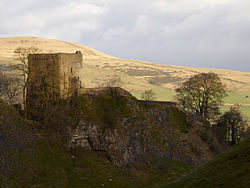
Peveril Castle (also Castleton Castle or Peak Castle) is a ruined 11th-century castle overlooking the village of Castleton in the English county of Derbyshire. It was the main settlement (or caput) of the feudal barony of William Peverel, known as the Honour of Peverel, and was founded some time between the Norman Conquest of 1066 and its first recorded mention in the Domesday Survey of 1086, by Peverel, who held lands in Nottinghamshire and Derbyshire as a tenant-in-chief of the king. The town became the economic centre of the barony. The castle has views across the Hope Valley and Cave Dale.
William Peveril the Younger inherited his father's estates, but in 1155 they were confiscated by King Henry II. While in royal possession, Henry visited the castle in 1157, 1158, and 1164, the first time hosting King Malcolm IV of Scotland. During the Revolt of 1173–1174, the castle's garrison was increased from a porter and two watchmen to a force led by twenty knights shared with the castles of Bolsover and Nottingham. The Earls of Derby had a claim to the Peveril family's estates through marriage, and in 1199 William de Ferrers, the fourth earl, paid 2,000 marks for the Peak lordship, although the castle remained under royal control. The closest Peveril Castle came to seeing battle was in 1216, when King John gave the castle to William de Ferrers, but the castellan refused to relinquish control. Although they were both John's supporters, the king authorised the earl to use force to evict the castellan, who eventually capitulated, although there is no evidence that the castle was assaulted.
In 1223 the castle returned to the Crown. In the 13th century there were periods of building work at the castle, and by 1300 its final form had been established. Toward the end of the 14th century, the barony was granted to John of Gaunt, Duke of Lancaster. Having little use for the castle, he ordered some of its material to be stripped out for re-use, marking the beginning of its decline. From the time of John of Gaunt to the present day, the castle has been owned and administered by the Duchy of Lancaster. Peveril Castle became less important administratively, and by 1609 it was "very ruinous and serveth for no use". In the 19th century, Sir Walter Scott featured the castle in his novel Peveril of the Peak. The site is situated in a national park, and cared for by English Heritage. Peveril Castle is protected as a scheduled monument and a Grade I listed building.
275 m
Castleton Hall
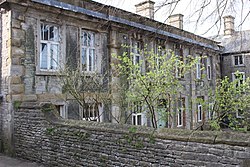
Castleton Hall is an 18th-century grade II listed country hall on Castle Street in Castleton, Derbyshire.