


Le Tempio Civico della Beata Vergine Incoronata (en français, « Temple civique de la Sainte Vierge couronnée ») est une église située à Lodi, en Lombardie, considérée comme l'un des chefs-d'œuvre de la Renaissance de l'art lombard. L'église a été conçue en 1488 par Giovanni Battagio (un élève de Bramante), continuée par Gian Giacomo Dolcebuono et achevée par Giovanni Antonio Amadeo.
Gallery


Sponsored
Location
1 explorer visited this place

9 m
The Tempio Civico della Beata Vergine Incoronata is a Catholic church in Lodi, Lombardy, Italy. It is considered one of the masterworks of the Lombard Renaissance art. The church was designed in 1488 by Giovanni Battagio, continued by Gian Giacomo Dolcebuono and finished by Giovanni Antonio Amadeo, and built at expenses of the Lodi commune, whence the denomination "Civico", on the site previously occupied by a brothel.
101 m
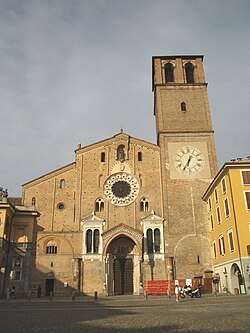
Lodi Cathedral is a Roman Catholic cathedral in Lodi, Lombardy, Italy. It is also a basilica minor. Dedicated to the Assumption of the Blessed Virgin Mary, it is the seat of the Bishop of Lodi. It is one of the largest churches in northern Italy.
193 m
The Biblioteca Laudense is the main public library located on Via Solferino #72, in the town of Lodi, in the region of Lombardy, Italy. The library is in the Palazzo San Filippo, once housing the convent and chapel of the Oratorians. It now houses the library and a Civic Museum of Lodi.

194 m
San Filippo Neri is a late Baroque-style Roman Catholic church located on Corso Umberto in central Lodi, region of Lombardy, Italy.

230 m
The Church of Sant'Agnese is a Gothic-style, Augustinian church in Lodi, Lombardy, a region of Italy. The church was expanded in 1393 by Bonifacio Bottigella when he became Bishop of Lodi. Bottigella oversaw the diocese until 1404. The church has been celebrated as representing a great moment in Lombard Gothic Architecture. The polygonal apse and two-tiered bell-tower are similar to that of the Lodi Cathedral.
L'édifice a été construit aux frais de la commune de Lodi d'où la dénomination de Civico (« Municipal »). L'église est construite sur un site précédemment occupé par une maison de prostitution.