
Location Image

The National (Scotland)

The National is a Scottish daily newspaper owned by Newsquest. It began publication on 24 November 2014, and was the first daily newspaper in Scotland to support Scottish independence. Launched as a response to calls from Newsquest's readership for a pro-independence paper in the wake of the 2014 Scottish independence referendum, it is a sister paper of The Herald, and as of 2025 was edited by Laura Webster. Initially published on weekdays, a Saturday edition was added in May 2015. The National is printed in tabloid format, and is also available via online subscription. Details of its launch were announced on 21 November, with further information given at a Scottish National Party (SNP) rally the following day. Upon its launch, The National stated that it is a separate entity from the Scottish National Party. It was launched on a five-day trial basis against the backdrop of a general decline in newspaper sales, with an initial print-run of 60,000 copies for its first edition, but this was increased the following day as a result of public demand, and Newsquest decided to print it on a permanent basis after healthy sales continued throughout the first week. The first front page carried a story about charities urging devolution of powers over welfare legislation to Scotland. Reception to the newspaper's launch was mixed in both media and political circles. Libby Brooks of The Guardian said that its international coverage was strong and that its news was "central belt-centric – and Holyrood-filtered". Labour peer George Foulkes branded it "McPravda". The Scottish journalist and broadcaster Lesley Riddoch, who later wrote for the paper, stated that its launch could be a "sound business move" by its publishers. By January 2015, daily sales had fallen to below 20,000. The following year, its print edition dropped below 10,000, and was being outsold by every Scottish regional daily newspaper with the exception of the Paisley Daily Express. The Sunday National was launched as a Sunday edition on 9 September 2018 as a replacement to its former sister title the Sunday Herald.

Nearby Places View Menu
Location Image
109 m

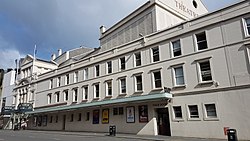
Theatre Royal, Glasgow

The Theatre Royal is the oldest theatre in Glasgow and the longest running in Scotland. Located at 282 Hope Street, at the Cowcaddens area, its front door was originally round the corner in Cowcaddens Street. It currently accommodates 1,541 people and is owned by Scottish Opera. The theatre opened in 1867, adopting the name Theatre Royal two years later. It is also the birthplace of Howard & Wyndham Ltd, owners and managers of theatres in Scotland and England until the 1970s, created by its chairman Baillie Michael Simons in 1895. It was Simons who as a cultural entrepreneur of his day also promoted the building of Kelvingrove Art Gallery and Museum and Glasgow's International Exhibitions of 1888 (the International Exhibition of Science, Art and Industry) and 1901; and the major extension and development of the McLellan Galleries just prior to WWI.
120 m

Alexandra Music Hall

Alexandra Music Hall, also known as the Royal Alexandra Music Hall, and as the Colosseum Hall in the early 1880s, was a music hall situated in the Cowcaddens area of Glasgow, Scotland. Built in 1867 and capable of holding 700 people it was part of the Theatre Royal complex developed by James Baylis. After changing its name to the Bijou Picture Palace in 1908 it continued to operate as a variety-cinema until 1929 before closing due to safety concerns. Scottish Television bought the entire Theatre Royal complex in the 1950s, using the old Alexandra Hall for storage until its demolishing in 1969 to create extra space for colour TV studios to the east of the Theatre Royal.
121 m

Royalty Theatre, Glasgow

The Royalty Theatre, Glasgow (later the Lyric Theatre) was a theatre in Glasgow at the corner of Sauchiehall Street and Renfield Street. It was built in 1879 as part of a development by the Central Halls Company chaired by David Rattray, and was one of the first theatre designs of Frank Matcham. In 1895 it was one of the four theatres brought together by Baillie Michael Simons of Glasgow in a new company Howard & Wyndham Ltd. The Royalty staged plays, opera, and musical comedy and later became home to repertory theatre The author and journalist Neil Munro had an association with the Royalty Theatre. In his Erchie MacPherson story, "Jinnet's First Play", first published in the Glasgow Evening News on 24 October 1904, Munro has Erchie take his wife Jinnet to a production of Arthur Wing Pinero's play Letty at the Royalty. Five years later, Erchie MacPherson featured as the main character in his play Macpherson, produced by the Scottish Playgoers Ltd. at the theatre in 1909. The Royalty became the Lyric Theatre in 1914 when it was sold to the YMCA. It was rebuilt after a fire in 1953 but demolished in 1959, and replaced by St. Andrew House, a large concrete office block, which is now an hotel.
Location Image
122 m

Buchanan Street railway station

Buchanan Street station is a former railway station in Glasgow. Less well known than the city's other terminus stations – Central, Queen Street and St Enoch – it was situated in the Cowcaddens district to the north-west of Queen Street station and served the north of Scotland.