

 English
 Français
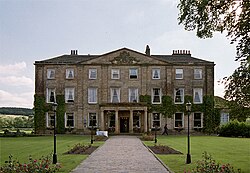
Walton Hall, West Yorkshire
Walton Hall is a country house in Walton near Wakefield in West Yorkshire, England. It was built on the site of a former moated medieval hall in the Palladian style in 1767 on an island in a 26-acre (11 ha) lake. It was the ancestral home of the naturalist and traveller Charles Waterton, who made Walton Hall into the world's first wildfowl and nature reserve.
Nearby Places View Menu

1.1 km
Walton, Wakefield
Walton is a village and civil parish in the City of Wakefield in the county of West Yorkshire, England, 4 miles south-east of Wakefield. At the time of the 2011 Census, the parish had a population of 3,231. At the time of the 2011 Census the parish was part of the City of Wakefield's ward of Crofton, Ryhill and Walton. The population of this ward at the Census was 15,144.
Historically part of the West Riding of Yorkshire, the village lies on the Barnsley Canal and is home to Walton Hall, once the residence of Charles Waterton, known as 'Squire' Waterton. He was a naturalist and explorer who, in 1820, transformed the grounds of the Walton Hall estate the world's first nature reserve. The estate is also often referred to on Ordnance Survey maps, etc., as Walton Park and, less frequently, as Walton Hall Park. More recently, it has become widely known as Waterton Park.
Walton Hall is now Waterton Park Hotel. The park is now largely given over to a golf course, also named Waterton Park. There are public rights of way crossing the park.
Nearby, the site of the now demolished Walton Colliery, formerly known as Sharlston West colliery, has been transformed into a nature park (Walton Colliery Nature Park). Large lakes were constructed when the reserve was landscaped in the mid-1990s and the excavated earth was then used to cover the colliery's vast spoil heaps. The village also contains a small park, a tennis club, football and rugby pitches, a newly renovated pub and a sports and social club.

1.6 km
Sandal and Walton railway station
Sandal and Walton railway station was opened on 1 June 1870 by the Midland Railway on its line from Derby to Leeds Wellington Station.
The station was south of Wakefield, lying between Sandal and Walton in West Yorkshire, England.
It was of typical Midland brick-built construction. In 1926 the line was quadrupled, with the new goods lines passing to the east of the two platforms. It closed on 12 June 1961.
To the north of the station a junction had been built in 1868 with a curve to meet the West Riding and Grimsby Railway jointly owned by the MS&LR and the GNR. This enabled goods services and southbound passenger trains to run from Wakefield. However this service finished during the First World War.

1.7 km
Hare Park & Crofton railway station
Hare Park & Crofton railway station, sometimes just known as Crofton railway station, was a station located on the West Riding and Grimsby Railway, this section now known as the Wakefield Line. It served the village of Crofton in West Yorkshire, England and is located around 3 miles (4.8 km) to the south-east of Wakefield. The station was opened in November 1885 and closed on 4 February 1952.
This site, in the West Yorkshire transport plan, has been suggested for a new station with the village of Crofton now having a population of over 6,000 as well as this, the proposal of a new railway station further down the line closer to New Crofton is cited in the Crofton village plan, to hopefully remove congestion in the village, and cut down on carbon emissions.

1.8 km
Chevet, West Yorkshire
Chevet is a civil parish in the City of Wakefield in West Yorkshire, England. It has a population in 2001 of 66. In the 2011 Census this civil parish was included in the ward of Wakefield South.
Chevet Hall was a country house which stood in an estate, part of which is now Newmillerdam Country Park. The house was built in 1529 by the Nevile family and was bought in 1765 by Sir Lionel Pilkington, 5th Baronet and passed down through the Pilkington family. In 1954 the estate was acquired as a country park by Wakefield Council, who demolished the hall in the 1960s.