

 English
 Français

Thornton-in-Craven railway station
Thornton-in-Craven railway station served the small village of Thornton-in-Craven in North Yorkshire (formerly the West Riding of Yorkshire), England. It was a stop on the Leeds and Bradford Extension Railway between Colne, Skipton and Bradford.
Nearby Places View Menu

355 m
Thornton in Craven
Thornton-in-Craven is a village and civil parish in the county of North Yorkshire, England. It is approx 1,740 feet (530 m) from the border with Lancashire and 1 mile (1.6 km) north of Earby. Barnoldswick is nearby. The Pennine Way passes through the village, as does the A56 road.
Until 1974 it was part of the West Riding of Yorkshire. From 1974 to 2023 it was part of Craven District. It is now administered by the unitary North Yorkshire Council.
The village has a church, a primary school and a retirement home, but no shops or pubs. The historic almshouses provide accommodation for five single persons. Near the medieval church to the west of the village is a holy well, dating from Saxon times and now covered by an octagonal structure erected in 1764 by the rector.
Thornton-in-Craven railway station was closed when passenger trains over the Skipton to Colne route were withdrawn in 1970. SELRAP are actively pursuing a re-opening of the line which was given a boost in February 2018, when the transport minister, Chris Grayling, ordered a feasibility study into the reopening.
The village playing field, at the bottom of Boothbridge Lane, is home to Thornton in Craven Cricket Club who compete in the Craven League. The team is heavily populated by players from nearby Earby and Barnoldswick, with a few representatives from the village itself. In 2022 the club were winners of the Third Division title and won the Cowling Cup.
Poet Blake Morrison grew up in the village.

1.7 km
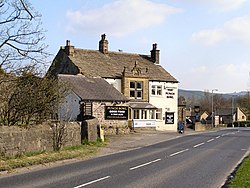
Church of St Mary le Ghyll, Barnoldswick
The Church of St Mary le Ghyll (also known as St Mary-le-Gill) is in Ghyll Lane, Barnoldswick, Lancashire, England. It is an active Anglican parish church in the deanery of Skipton, the archdeaconry of Craven, and the Diocese of Leeds. Its benefice is united with those of Holy Trinity, Barnoldswick, and St Michael, Bracewell. The church is recorded in the National Heritage List for England as a designated Grade I listed building.
1.9 km
Earby
Earby is a town and civil parish within the Borough of Pendle, Lancashire, England. Although within the boundaries of the historic West Riding of Yorkshire, Earby has been administered by Lancashire County Council since 1974 and regularly celebrates its Yorkshire roots. It is 5 miles (8 km) north of Colne, 7 miles (11.3 km) south-west of Skipton, and 11 miles (17.7 km) north-east of Burnley. The parish had a population of 4,538 recorded in the 2011 census.

2.1 km
Elslack Hall
Elslack Hall is a historic building in Elslack, a village in North Yorkshire, in England. Today it has been subdivided into a farm house and cottage.
The building may be the successor of a manor house which Godfrey de Altaripa was granted a licence to crenellate in 1318. Remains of a moat are visible around the site, and there are a couple of lancet windows which may have been part of the mediaeval building. The oldest parts of the current house probably date from the 16th century. It was altered in the 18th century, and then suffered a fire in the late 19th century. As a result of the damage, the left rear wing was demolished, and the building was refronted. The house was grade II* listed in 1954. It forms part of the Elslack Estate, which was put up for sale in 2016, with an asking price of £10 million.
The house is built of stone, with quoins and a stone slate roof, one gable with a crocketed finial. There are two storeys, two bays, and a cross-wing on the right. On the front is a two-storey porch and a round-headed doorway with impost blocks and voussoirs. The windows have double-chamferd mullions, and on the gabled end are two six-light windows, each light arched, with hood moulds. Attached to the cross-wing is a garden wall containing two rectangular bee boles with shelves.
In front of the house is a great barn, which was constructed in 1672. It is built of stone with quoins and a stone slate roof. It is rectangular, long and narrow. The openings include a doorway with a chamfered surround, a doorway with a Tudor arch, two cart entries with chamfered surrounds and elliptical heads, and vents. Over one cart entry is a dated and initialled stone. It was grade II listed in 1954.