


La bataille de Glen Shiel est une victoire de l'armée britannique sur les jacobites écossais et l'armée espagnole pendant le soulèvement jacobite de 1715, qui constitue un conflit annexe de la guerre de la Quadruple-Alliance.
Gallery


Sponsored
Location

0 m
The Battle of Glen Shiel took place on 10 June 1719 in the Scottish Highlands, during the Jacobite rising of 1719. A Jacobite army composed of Highland levies and Spanish marines was defeated by British government troops.
The Rising was backed by Spain, then engaged in the 1718–1720 War of the Quadruple Alliance with Britain. Originally intended to support a landing in south-west England, which was cancelled several weeks earlier, its failure was seen as having fatally damaged the Jacobite cause.
The battlefield is now included in the Inventory of Historic Battlefields in Scotland, and protected by Historic Scotland.

1.9 km
Sgùrr na Ciste Duibhe or Sgùrr nan Cisteachan Dubha is a mountain in the Northwest Highlands of Scotland, one of the 'Five Sisters of Kintail'. It is on the northern side of Glen Shiel, 27 kilometers southeast of Kyle of Lochalsh. Its height is 1,027 metres and it is classed as a Munro.

2.4 km
Creag nan Damh is a mountain with a height of 918 metres in the Northwest Highlands of Scotland. It lies south of Glen Shiel, near Kinloch Hourn. A rocky and craggy peak, it is usually the last Munro to be climbed.

3.2 km
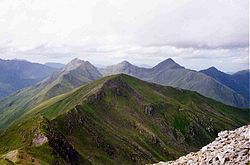
Sgùrr na Càrnach is a mountain in the Northwest Highlands of Scotland, one of the 'Five Sisters of Kintail'. It is on the northern side of Glen Shiel, 24 kilometres southeast of Kyle of Lochalsh. It reaches a height of 1,002 metres and is classed as a Munro. The summit is rough and boulder-ridden, living up to its Gaelic name which means "peak of the stony place".
From 1891 to 1997 Sgùrr na Càrnach was ranked as just a "Top" of the nearby Munro of Sgùrr Fhuraran and was not given separate Munro status, however in the 1997 revision of the tables by the Scottish Mountaineering Club, the mountain was elevated to the Munro category as it was decided that with 134 metres of topographic prominence it had the required characteristics of a separate mountain.
Sgùrr na Càrnach has extremely steep slopes to the east and west, the western slopes descend sharply to Glen Shiel while to the east the mountain falls precipitously into Coire Domhain. The mountain has a main north to south ridge which connects to Sgùrr Fhuraran and Sgùrr na Ciste Duibhe. There is a minor north western ridge which descends sharply to Glen Shiel, however this is rarely used as a means of ascent because of difficulties crossing the River Shiel in the valley and of the unremitting steepness of the ridge itself.
Because of Sgùrr na Càrnach's central position of the three Munros which make up the Five Sisters of Kintail it is invariably approached along the ridge from either Sgùrr Fhuraran or Sgùrr na Ciste Duibhe as walkers complete the full Five Sisters ridge walk. A direct ascent is possible, as mentioned, up the north west ridge. The best starting place for this direct ascent is Achnangart Farm where there is parking space in an old quarry, a direct ascent up the hillside should not be attempted as there are steep crags higher up. The walker should walk 1.5 km north to the base of the NW ridge and ascend steeply but safely from there. The most common ascent starts further up the Glen and climbs to the Bealach na Lapain before crossing Sgùrr na Ciste Duibhe to reach Sgùrr na Càrnach. The view from the top of the mountain gives a fine end on view of Loch Duich to the north and an aerial prospect down into Coire Domhain to the east.