

 English
 Français
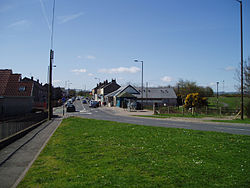
Cowie, Stirling
Cowie (Scottish Gaelic: Collaidh, meaning wooded place) is a village in the Stirling council area of Scotland. Historically part of Stirlingshire, it lies on the minor B9124 road approximately 4 miles (6 kilometres) southeast of Stirling and about 1 mile (1.5 kilometres) north of the A9 road. The United Kingdom Census 2011 recorded the population as 2,713. Excavations have identified Mesolithic and Neolithic settlement remains at Chapelfield. Cowie was formerly a pit village and stone quarrying was carried on in the surrounds. It is now the site of a factory manufacturing engineered wood products and other light industries. Recent years have seen significant new housing developments in the village for commuters.
Nearby Places View Menu
815 m
Plean railway station
Plean railway station served the village of Plean, Stirlingshire, Scotland from 1904 to 1956 on the Scottish Central Railway.

2.2 km
Plean
Plean is a village, in the Stirling council area of central Scotland, located on the main A9 road from Falkirk. At the 2001 census, Plean had a population of 1,740. Plean has some historic buildings, some council houses and an estate.

2.2 km
Throsk
Throsk (In Scottish Gaelic: Badan Deathach, meaning the thicket among the mist) is a village in the Stirling council area of Scotland. It lies on the A905 road east of Fallin close to the River Forth. The United Kingdom Census 2001 recorded the population as 231.
Throsk was formerly the site of the Royal Navy's Bandeath armaments depot. This closed in 1978 and now serves as an industrial estate owned by the local council. Many of the original munitions storage bunkers remain in situ as does a loading crane beside the River Forth.
There was a rail bridge between Throsk and Alloa sometime called the Alloa Swing Bridge of which some video footage survives.

2.4 km
The Gothenburg, Fallin
The Gothenburg, or simply The Goth, is a community-run pub in the former mining village of Fallin, near Stirling, Scotland.
Founded in 1910, it is one of the few remaining pubs in Scotland still run under the Gothenburg system, with at least 95% of the profits donated to community causes. During miners' strikes, The Goth hosted soup kitchens and supported miners' strike funds. It remains as a marker of the village's mining history.
The Goth has close ties with the neighbouring bowls club.