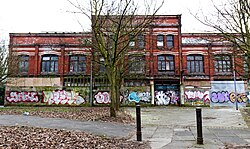
Hulme Crescents was a large housing development in the Hulme district of Manchester, England. Hulme was the largest public housing development in Europe, encompassing 3,284 deck-access homes and capacity for over 13,000 people, but was marred by serious construction and design errors. Demolition of the Crescents, comprising 923 dwellings, began in 1993, 21 years after it was constructed in 1972. The Crescents were described by the Architects' Journal as "Europe's worst housing stock... hideous system-built deck-access block which gave Hulme its unsavoury reputation." The Hulme Crescents had implications for new housing in Manchester and signalled the end of the streets in the sky idea popular throughout the 1960s and 1970s in the United Kingdom. After demolition, Hulme was redeveloped in the 1990s with a mix of low-rise to medium-rise housing.

Lieux à Proximité Voir Menu
Location Image
275 m

St Wilfrid's Church, Hulme

St Wilfrid's Church in George Street, Hulme, Manchester, England, is a former Roman Catholic church. Designed by Augustus Pugin, it was his only known church building in that city. Construction of St Wilfrid's began in 1839 and the church building was completed in 1842, although a planned tower was never built. The church served a small number of Irish people who lived in the area. In July 1852, during a period of anti-Catholic demonstrations, the building was mistakenly rumoured to be the target of Protestant people who desired to burn it down. There had been sectarian riots in nearby Stockport in the previous month and the heightened tensions led to a fight in a pub becoming misconstrued as an imminent attack on the church. A large mob of Irish people arrived to defend the building against this non-existent threat and, although the priest, Reverend Toole, attempted to calm them and urged them to disperse, for several days afterwards a group of people stood watch over it. The church had the services of Irish priests from County Kerry continuously from the 1890s until the 1930s. St Wilfrid's became a Grade II listed building in December 1963. Facing declining enrollment, the parish was suppressed and the church was deconsecrated in 1990. The church was converted into a factory that manufactured beds and in 1994 became an enterprise centre. Among those buried at the church was William Bally, a Swiss sculptor and phrenologist.
Location Image
310 m

Hulme Community Garden Centre

Hulme Community Garden Centre (HCGC) is a garden and community centre in Hulme, Manchester, England. It was featured in a 2017 episode of the TV show Gardener's World.
Location Image
359 m

Hulme Hippodrome

The Hulme Hippodrome in Manchester, England, is a shuttered Grade II listed building, a proscenium arch theatre with two galleries and a side hall. It was originally known as the Grand Junction Theatre and Floral Hall, and opened on 7 October 1901 on the former main road of Preston Street, Hulme, (now Clopton Walk) and with stage access is from Warwick Street. The Hulme Hippodrome theatre is located in the same building and shares a party wall with its small sibling theatre, The Playhouse. The Hippodrome was a music hall and variety theatre, a repertory theatre in the 1940s, and hired on Sundays for recording BBC programmes with live audiences between 1950 and 1956. In the 1960s and 1970s it was a bingo hall, and from 2003 used by a disgraced church. The theatre has been closed since 2018 and a campaign group exists to bring it back into use as a community resource, where the current owner is seeking permission to build apartments. Its local name in memoirs and records is 'Hulme Hipp'. Its national heritage significance includes being the venue for live recording the first three series of BBC programmes by the comedians Morecambe and Wise.
Location Image
370 m

Playhouse Theatre, Manchester

The Playhouse Theatre, as of 2024 a community arts centre called the Niamos Centre, is a theatre in Hulme, Manchester, England. It is a grade II listed building. Originally built as the Hulme Hippodrome in 1902 with a name swap in 1906, the building has also been known as the Grand Junction Theatre, Junction Picture Theatre, The Playhouse, and the Nia Centre. Between 1955 and 1986 it was used as studios by the BBC and known as the BBC Playhouse.