

 English
 Français

Bardsley, Greater Manchester
Bardsley is a suburban area of Oldham, in Greater Manchester, England. It lies on undulating land by the River Medlock, on Oldham's southern boundary with Ashton-under-Lyne in the Metropolitan Borough of Tameside.
Nearby Places View Menu

547 m
Fairbottom Bobs
Fairbottom Bobs is a Newcomen-type beam engine that was used in the 18th century as a pumping engine to drain a colliery near Ashton-under-Lyne. It is probably the world's second-oldest surviving steam engine. The engine was installed at Cannel Colliery at Fairbottom near Ashton-under-Lyne around 1760 or 1764. It became known locally as Fairbottom Bobs.
The engine's origin is unclear. It was possibly first installed at Norbury Coal Works about 9 mi (14 km) to the west from where the Manchester Mercury for 9 October 1764 carried an advertisement for a 'Fire Engine' for sale. Its cylinder dimensions matched the Fairbottom engine.
The engine's design and construction have been described as "primitive". It had a power rating of 11 horsepower. Its cylinder has an 28 inches (710 mm) bore and 8 feet (2.4 m) stroke, driving a water pump with a 8 inches (200 mm) bore that could raise water from a depth of 240 ft at a rate of 14 strokes per minute. The timber beam consisted of single wooden king post with wrought iron straps and wooden arch heads at each end. Iron chains linked the beam to the piston rods. An auxiliary arch head drove the engine's air pump. The beam was supported on a pillar of dressed stone resembling a thick wall or narrow pyramid, rather than on the wall of an engine house, a feature found on other engines of this age but rare later. Although foundations and stone floors survive on its site, there is no evidence of an engine house or roof to protect the engine from the weather.
As was common for mine drainage, pumping at one pit could drain water across a number of pits. The water produced was used to maintain water levels in the Ashton Canal by draining into the Fairbottom Branch Canal at Fennyfield Bridge, just south of the engine. In 1801 the canal company was approached to contribute to the costs of its refurbishment, work that may have been carried out by Bateman and Sherratt engine builders of Manchester. The original pit appears to have been worked out in the 1820s, although others nearby were working as 'Fairbottom Pits'. Draining the old mine workings and supplying water to the canal kept the engine working after the Cannel Colliery closed until the engine was abandoned in 1826 or 1827.

954 m
Park Bridge railway station
Park Bridge railway station was a stop on the Oldham, Ashton-under-Lyne and Guide Bridge Junction Railway (OA&GB) that served the village of Park Bridge in Tameside, Greater Manchester, England. It was located in the Medlock Valley near Ashton-under-Lyne's border with Oldham. It was sometimes known as Parkbridge; one photograph of the station shows the station name board with the name as one word and immediately adjacent the signal box with it shown as two.
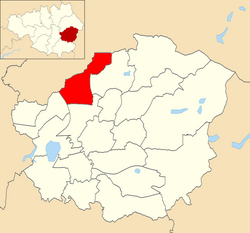
969 m
Ashton Waterloo (ward)
Ashton Waterloo is an electoral ward of Tameside, England. It is represented in Westminster by Angela Rayner Labour MP for Ashton-under-Lyne.

1.0 km
Fitton Hill
Fitton Hill is a large housing estate in the town of Oldham in Greater Manchester, contiguous with Hathershaw and Bardsley.
Lying 2 miles south of Oldham town centre, the Fitton Hill estate was built during the 1950s and 1960s on previously undeveloped moorland with scattered hamlets and farmsteads. The layout of the estate obliterated all traces of the old landscape.
Two churches serve the area, the Roman Catholic church of Holy Rosary and St Cuthbert's, Church of England. The Holy Rosary, opened in 1955, contains a significant mural by Georg Mayer-Marton.
Three primary schools serve the area, Medlock Valley Community School, St Martin's School and Holy Rosary RC Primary. See List of schools in Oldham.