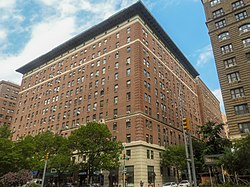
The Astor Court Building is a 12-story, 164 unit apartment building on Broadway between West 89th Street and 90th Street on the Upper West Side of Manhattan in New York City, built in 1916. It was designed by architect Charles A. Platt for developer Vincent Astor. The twelve-story building is constructed around a landscaped courtyard.
Location
1 explorer visited this place

58 m
Murray's Sturgeon Shop is an appetizing store and neighborhood fixture in Manhattan's Upper West Side. It is located on Broadway between 89th Street and 90th Street.

103 m
The Cornwall is a luxury residential cooperative apartment building at 255 West 90th Street on the Upper West Side of Manhattan, New York City. Located on the northwest corner of Broadway and 90th Street, it was designed by Neville & Bagge and erected in 1909. The developers were Arlington C. Hall and Harvey M. Hall. The twelve-story brick and stone building is noted for its elaborate balcony and window detail, and the "spectacular" design of its "extraordinary" ornate Art Nouveau cornice, which the AIA Guide to New York City called "a terra-cotta diadem." In 1991, the building's owner-occupants paid $600,000 to have the cornice and ornamented balconies replaced with terra cotta replicas of the originals.
Notable residents include New York Times "Streetscape" columnist and architectural historian Christopher Gray.

117 m
The Greystone, also known as the Greystone Hotel, is a fourteen-story building at 212-218 West 91st Street on the Upper West Side of Manhattan in New York City, United States. Samuel and Henry A. Blumenthal bought the property from the Astor estate in 1922 with marketing beginning two years later. It was designed by the architectural firm of Schwartz & Gross.
The building is currently in residential use and the former ballroom has since been a series of restaurants including Polistina's and Big Daddy's.
Among its notable residents was
Alberto Arroyo.
The sixth Rebbe of Chabad-Lubavitch, Rabbi Yosef Yitzchak Schneersohn.

126 m
Congregation Shaare Zedek is a non-denominational synagogue located on West 93rd Street in Manhattan, New York City, New York, United States. In 2017, despite the efforts of preservationists to save it, a New York State Supreme Court judge approved the sale of the building to a developer who planned to tear it down and build a 14-story condominium.

127 m
The 91st Street station was a local station on the IRT Broadway–Seventh Avenue Line of the New York City Subway. It was located at 91st Street and Broadway on the Upper West Side of Manhattan.
The 91st Street station was constructed for the Interborough Rapid Transit Company as part of the city's first subway line, which was approved in 1900. Construction of the line segment that includes the 91st Street station began on August 22 of the same year. The station opened on October 27, 1904, as one of the original 28 stations of the New York City Subway. The station was closed on February 2, 1959, as a result of a platform lengthening project at the two adjacent stations, 86th Street and 96th Street.
The 91st Street station contains two abandoned side platforms and four tracks. The station was built with tile and mosaic decorations. Many of these decorations have been covered with graffiti.
Architectural historian Christopher Gray believes that the landscape architect may have been Ellen Biddle Shipman. The building became a co-op in 1985. Famous residents include Joy Behar from The View.