


Punjwarian (Urdu: پنجوڑیاں) is a village situated near Kharian city in the Gujrat District of Punjab, Pakistan. It is located close to Kharian Cantonment, approximately 12 kilometers from the city center. The majority of the village’s population belongs to the Rajput Bhatti tribe.
Location
1 explorer visited this place
1.5 km
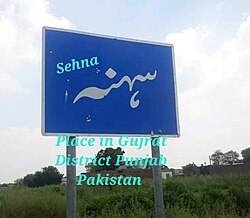
Sehna is a town and union council of Gujrat District, in the Punjab province of Pakistan. It is part of Kharian Tehsil
[Sehna is a large and prominent village in Tehsil Kharian, District Gujrat, Punjab, Pakistan. The village has a Government Boys High School, a Government Girls High School, and a primary school. Many residents are well-educated and work in reputable organizations. The people of Sehna are skilled and actively contribute to their community. The village elders and prominent members strive for its prosperity and aim to ensure a bright and successful future for the coming generation]
Sehna village is predominantly inhabited by people of the Arain caste, and it is known for being a clean and well-maintained village. The Numberdar position in the village has been held by the same family for generations, and the current officially Numberdar is.
2.1 km
Naseera is a small town in the Sehna union council of Kharian city, Gujrat District, Punjab, Pakistan. A natural "Kass" some time "Kassa" Nala flows as a boundary between Kharian Cantt and Naseera. The main families are Rajput who are descendants of the Chib Rajput of Jandi Chontra, [[Baba Shadi Shaheed]]. Other families are Mughals Mirza who trace their lineage to the Mughals of Chakwal and Kashmir.
2.1 km
Dhall Kakka is a medium size village comprising approximately 600 houses in the tehsil of Kharian, Gujrat District, in the Punjab province of Pakistan.
The word Dhall is used for a number of different things, including a shield or buckler. Dhall is a clan of the Jutt tribe. the people belonging to the Dhall clan live in India and Pakistan. Possibly the people belonging to Dhall clan lived here before partition. Presence of Dhall clan is evident in census of 1901 and 1911 in the Pakistani punjab. It is said that Kakka was a landlord of the area during 16th century. Probably he belonged to the Dhall clan of the Jutt tribe. Meaning of name Kakka is not exactly known but Kakka in punjabi language is taken as a grey, however its origin dates back to Indus Valley Civilization and it was given as a surname to respected people. Baba Kakka had three sons Barkhurdar, Hayat Muhammad and Khushi Muhammad.
People of many tribes and clans live in the village mostly Muslim Jutt.
Before Indo-Pak partition, Hindus also lived along with Muslims however, after their departure in 1947 the village welcomed migrants from Kashmir. The original village consists of narrow brick paved streets surrounded by a ring of major street. However over a past few decades construction of new houses has spread over suburbs.
Historically main source of income for residents of Dhal Kakka was through agriculture and cattle farming. Muslim residents enjoyed close trade ties with Hindu neighbours. However now major source of money for the residents comes from hardworking professionals working abroad in Europe, Middle East and United States. Village Dhal Kakka has produced many respectable Teachers, Civil Servants, Military Servicemen, Businessmen, Engineers and Doctors.
Dhal Kakka is known for its Bull racing, Wrestling, Football, Cricket, Islamic education and female education.

3.1 km
Golra Hashim Urdu pronunciation: [golrɑːhɑːshim] is a small village in Kharian Tehsil, Gujrat District in Punjab province, Pakistan. Its nearby villages are Bhagwal, Kotla Haji Shah, Jhantla, Shorian, Chak Bakhtawar, Chak Budho, and Malka. It is situated at 32° 50' 17N 73° 56' 56E. It is part of Union council Bhagwal.

3.3 km
Bhagwal Urdu pronunciation: [bhɑːgˌwɑːl] is a village and union council of Kharian Tehsil, Gujrat District, in the Punjab province of Pakistan. Bhagwal is approximately 131 kilometres from the national capital Islamabad.