

 English
 Français

The Howff
The Howff is a burial ground in the city of Dundee, Scotland. Established in 1564, it has one of the most important collections of tombstones in Scotland, and is protected as a category A listed building. The majority of graves face exactly due east.
Nearby Places View Menu

146 m
High School of Dundee
The High School of Dundee is a private, co-educational, day school in Dundee, Scotland, which provides nursery, primary and secondary education to just over one thousand pupils. Its foundation has been dated to 1239, and it is the only private school in Dundee.
The school's rector is a member of the Headmasters' and Headmistresses' Conference.
The school has been registered as a charity in Scotland since July 1897.

192 m
Gardyne's Land, Dundee
Gardyne's Land is a complex of five historic buildings on the High Street, Dundee, Scotland. They are the oldest domestic buildings in that city.

196 m
Dundee
Dundee ( ; Scottish Gaelic: Dùn Dè or Dùn Dèagh, pronounced [t̪un tʲeː]) is the fourth-largest city in Scotland. The 2020 mid-year population estimate for the locality was
148,210. It lies within the eastern central Lowlands on the north bank of the Firth of Tay, which feeds into the North Sea.
Under the name of Dundee City, it forms one of the 32 council areas used for local government in Scotland. Within the boundaries of the historic county of Angus, the city developed into a burgh in the late 12th century and established itself as an important east coast trading port. Rapid expansion was brought on by the Industrial Revolution, particularly in the 19th century when Dundee was the centre of the global jute industry. This, along with its other major industries, gave Dundee its epithet as the city of "jute, jam and journalism".
With the decline of traditional industry, the city has adopted a plan to regenerate and reinvent itself as a cultural centre. In pursuit of this, a £1 billion master plan to regenerate and to reconnect the Waterfront to the city centre started in 2001 and is expected to be completed within a 30-year period. The V&A Dundee – the first branch of the V&A to operate outside of London – is the main centrepiece of the waterfront project. Today, Dundee is promoted as "One City, Many Discoveries" in honour of Dundee's history of scientific activities and of the RRS Discovery, Robert Falcon Scott's Antarctic exploration vessel, which was built in Dundee and is now berthed at Discovery Point.
Dundee is an international research and development hub in technology, medicine and life sciences, with technological industries having arrived since the 1980s. Dundee was named as a "City of the Future" by Cognizant in 2021, the only UK city to be featured. Dundee is also a leading city in AI, cybersecurity, fintech and electric vehicles where the city has one of the largest fleets of electric vehicles in the country. The city was named as the electric vehicle capital of Europe in 2018, and it has continuously been branded as the electric vehicle capital of Scotland and the United Kingdom.
In 2014, Dundee was recognised by the United Nations as the UK's first UNESCO City of Design for its diverse contributions to fields including medical research, comics and video games. Since 2015, Dundee's international profile has risen. GQ magazine named Dundee the "Coolest Little City in Britain" in 2015 and The Wall Street Journal ranked Dundee at number 5 on its "Worldwide Hot Destinations" list for 2018.
203 m
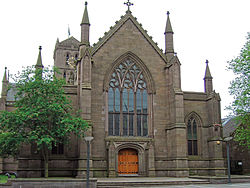
Dundee Parish Church (St Mary's)
Dundee Parish Church (St Mary’s) is located in the east section of Dundee's "City Churches", the other being occupied by the Steeple Church. Both are congregations in the Church of Scotland, although with differing styles of worship.
Dundee played an important role in the Reformation, and John Knox asserts in his History of the Reformation that "the first face of a public church Reformed" was that of St Mary's in Dundee, by 1556.
The church dates back to 1190, when it was founded by David, Earl of Huntingdon, brother of William the Lion, King of Scots. The original buildings have not survived. In 1303 the church was burnt by an invading English army. Following a further invasion in 1547 the church was burnt down again. In the late Middle Ages, Dundee's was the largest parish church in Scotland with the Old Steeple, built in the 1470s during the Provostship of George Spalding, the tallest tower.
In 1841 three of the City Churches were again destroyed by fire. Two were rebuilt, the South Church or St Paul's and the East Church or St Mary's. St Mary's, now known as Dundee Parish Church (St Mary's) was rebuilt being completed in 1844 to the design of William Burn. In 1847 the rebuilt South Church was reopened under the name St Paul's (South) Church.
The Old Steeple dates back to the 1480s. Between 1782 and 1841 there were no fewer than four Church of Scotland congregations occupying the City Churches under one roof but with separate sanctuaries. After the post 1841 rebuilding there were three congregations, then two since the 1980s – namely Dundee Parish Church (St Mary’s) and the Steeple Church.
Several past ministers have served as Moderators of the General Assembly of the Church of Scotland, most recently the late Very Reverend Dr William B. R. Macmillan in 1991.