


Santa Teresa Gallura (en sarde Lungone, en gallurais Lungoni) est une commune italienne de la province de Gallura-Sardaigne Nord-Est, en Sardaigne, dans la région de Gallura.
Book your tour near
Santa Teresa Gallura
Book Now
4.5
in partnership with
GetYourGuide.com
Gallery



Sponsored
Location
3.8 km
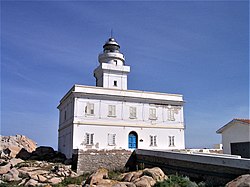
Capo Testa Lighthouse is an active lighthouse located on a promontory, which is the northernmost point of Sardinia, and represents the western entrance to the Strait of Bonifacio. Cape Testa promontory is connected to the mainland by an isthmus and the structure is situated in the municipality of Santa Teresa di Gallura on the Sea of Sardinia.
8.3 km
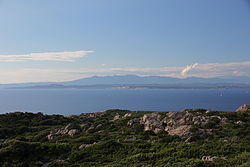
The Strait of Bonifacio is the strait which connects the islands of Corsica and Sardinia. It is named after the Corsican town Bonifacio, the most southerly on the island, which was in turn named after Boniface I, Margrave of Tuscany, who founded a citadel in its location circa 828AD.

11.9 km
The Isuledda, also called Isola dei Gabbiani, is an almost-island in northern Sardinia, Italy, facing the Sardinian channel. Covering an area of approximately 180,000 m2, it is almost completely surrounded by the sea, and connected to the mainland by a narrow isthmus of sandy terrain, hence, despite the name, it is in fact a peninsula. It is situated close to the località of Porto Pollo and Barrabisa.
The name "Isola dei Gabbiani" comes from the name of the camping that occupied the whole surface up to 2008. The area is administered by the comune of Palau. Due to its windy climate, it is a common destination for windsurfers and kitesurfers. The place is particularly favorable to the practice of these sports thanks to the optimal exposition to winds from north-west, which are dominant in the Mediterranean Sea.
We got there in a wonderful spot, in a day with more than 40 knots of mistral. In front of us two big bays; the crystalline and turquoise water and the possibility to choose whether to sail on a one metre high chop or on flat water as in a salt lake. All that in complete safety, with sandy depth and the coast line within a mile all around: a perfect natural gym!
13.3 km
Spargi is an island of Italy. It is situated in the Maddalena archipelago, in the Strait of Bonifacio between Corsica and Sardinia. It is the third largest island in the archipelago, and is uninhabited. It is within the Arcipelago di La Maddalena National Park.
The landscape is rugged granite, with some porphyry. The island is more-or-less circular. The only source of fresh water is rainfall. The coast is marked by coves and sandy beaches. The hinterland is almost impenetrable. Plant life includes Cistus, strawberry tree, juniper and mastic. During the 19th century, Natale Berretta, an alleged bandit, hid on the island and managed to elude searchers. When his name was cleared, he brought his family over and settled down.
The Spargi wreck is a Roman ship 35 m dating from c. 120 BC, discovered in 1939. It was a cargo vessel, carrying amphorae of wine. Finds from it are conserved in the Nino Lamboglia Museum in La Maddelena.
Spargi was garrisoned during both World Wars. Some of the fortifications still remain.
The ownership of Spargi was the subject of a lightly-contested court case in 2011. The parties agreed that it was worth €127,000.
The nearby islet of Spargiotto to the west is a breeding site for birds such as shag, Audouin's gull and storm petrel.
Secca di Spargi is a recommended and marked-out area for diving. It consists of large blocks of granite together with boulders and landslips, and includes tafoni and depressions. It ranges in depth from 6 m to 25 m. Fish include grouper, meagre, sea bream and barracuda. The sunlit areas support seaweed; the shady areas are populated by the sponge Aplysina cavernicola and red gorgonians.

14.3 km
Budelli is an island in the Maddalena archipelago, near the strait of Bonifacio in northern Sardinia, Italy. It is one of the seven islands that comprise Arcipelago di La Maddalena National Park. Budelli beach is famous for the color of its sand, which is pink due to the presence of shell fragments of a protozoan, Miniacina miniacea.